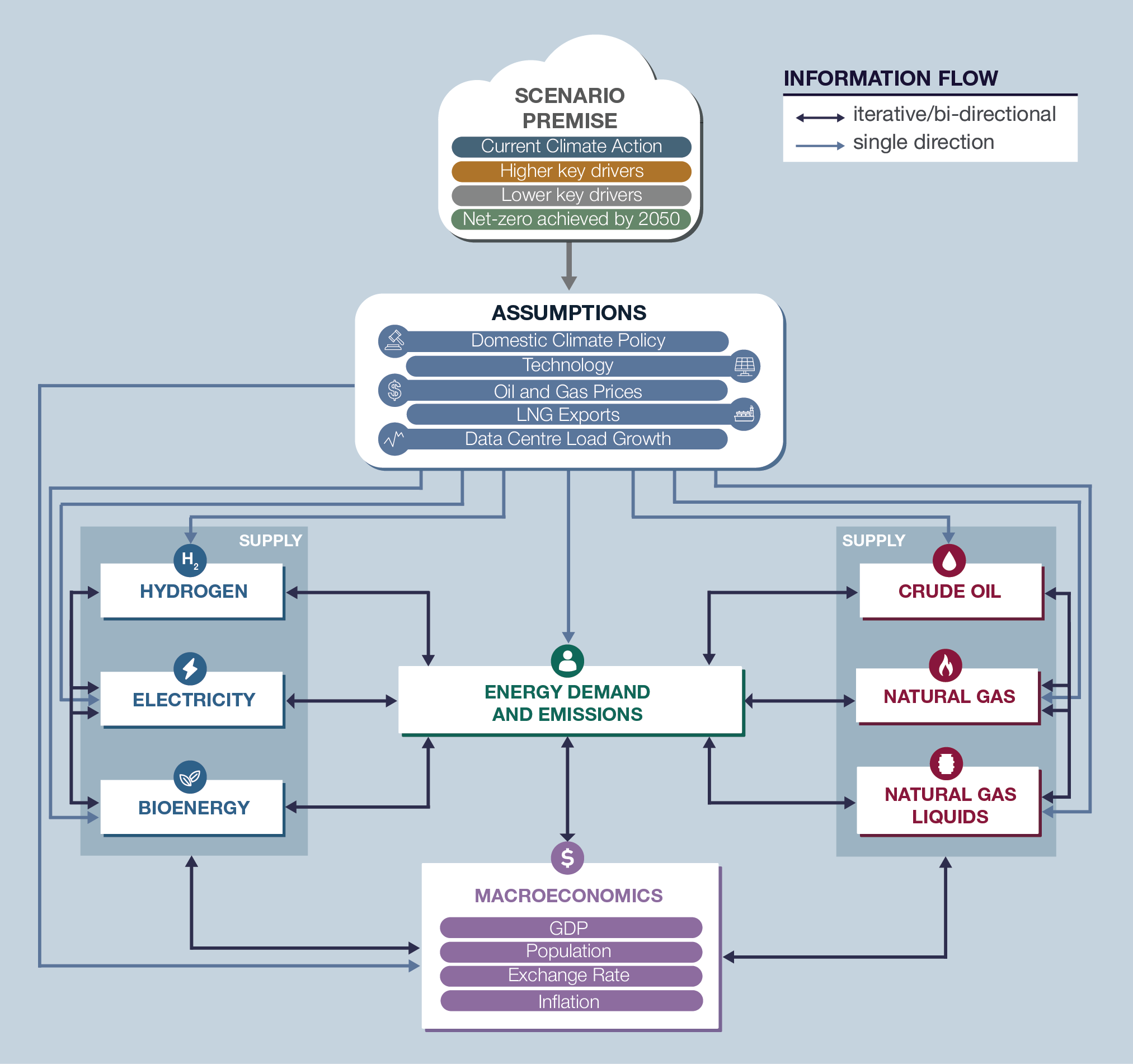
The projections in Canada’s Energy Future 2026: Energy Supply and Demand Projections (EF2026) are created with the Canada Energy Regulator (CER)’s Energy Futures Modeling System. The Energy Futures Modeling System turns the assumptions chosen for each scenario into projections of Canadian energy supply and demand. The Energy Futures Modeling System is a collection of separate models (e.g., Energy Demand and Emissions Model, Crude Oil Production Model, etc.) that draw upon the same batch of scenario assumptions. For example, the global oil price (an assumption) drives crude oil production in the Crude Oil Model, while also driving end-use gasoline and diesel prices in the Energy Demand and Emissions Model. The models interact as outputs of one model can be key inputs for another model. For example, electricity demand projections from the Energy Demand and Emissions Model influence the electricity capacity and generation projections in the Electricity Model. Figure MS.1 illustrates the Energy Futures Modeling System as a whole.
Source: CER
Text Alternative: This flow diagram provides a simplified overview of the information flow in the Canada’s Energy Futures Modeling System. It starts with a given scenario premise. The scenario premise is turned into assumptions on factors like domestic climate policy, technology, oil and natural gas prices, LNG exports, and data centre load growth. These assumptions feed into the energy models: energy demand, hydrogen, electricity, bioenergy, crude oil, natural gas, and natural gas liquids. The models exchange information with each other. All models exchange information with energy demand and macroeconomics. The hydrogen, bioenergy, and electricity models exchange information with each other, as do the crude oil, natural gas, and natural gas liquids models.
Information about how the individual models work, level of detail of data and assumptions, and key inputs and outputs is available on each model’s page below.
For more information about the specific assumptions used in EF2026, the report itself, or access to the report’s datasets, please see: main report page.
For more information on the Energy Futures Modeling System, contact: energyfutures@cer-rec.gc.ca