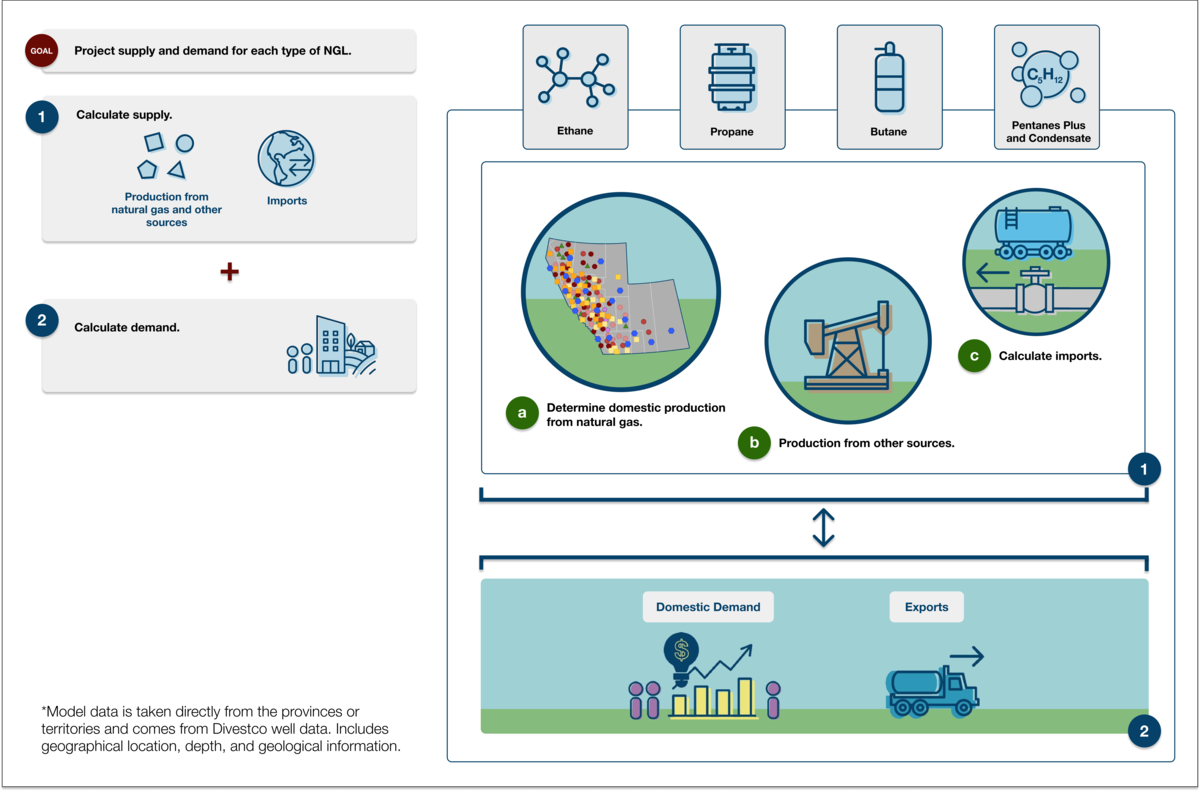
The Natural Gas Liquids (NGL) model covers ethane, butane, propane, condensate, and pentanes plus production. As a group these hydrocarbons are referred to as NGLs. For each NGL, the model provides estimates of production and supply and demand at the provincial or territorial level. The model is developed by CER staff.
NGLs are predominantly produced by processing natural gas from the Western Canadian Sedimentary Basin (WCSB) and production is heavily dependent on the natural gas production projections and NGL content of that natural gas. Some NGLs are also produced as a by-product of oil refining or bitumen upgrading. Production from refineries and upgraders is tied to their output of refined petroleum products and synthetic crude oil. NGL exports are generally calculated by subtracting demand from production by region. If there is more production than demand in a region it is assumed the remainder will be exported. If there is less production than demand it is assumed the shortfall will be imported. The exception to this is US imports of ethane, propane, and butane which are assumed to remain flat over the long term.
Source: CER
Text Alternative: The infographic provides a simplified visual overview of the natural gas liquids (NGL) supply and demand model. The model calculates Canadian production and demand by type of NGL based on natural gas production with other sources, such as refineries and upgraders, providing small amounts of additional supply. If supply exceeds demand in a region the difference is assumed to be exported. If demand exceeds supply the shortfall is assumed to be imported.
| Input | Source and description Values in bold refer to an input that comes from another section of the Energy Futures Modeling System (Figure MS.1). |
|---|---|
| Natural gas production | Natural gas production levels from the Natural Gas model drive a big part of NGL production. |
| NGL prices | Assumed prices for NGLs influence how much is extracted from the gas streams. Generally, NGL price assumptions follow trends in crude oil prices, consistent with the scenario’s Assumptions. |
| Gas compositions | Molar compositions (from the gas-analysis data) lead to a specified amount NGL production for a given amount of marketable natural gas production (barrels per million cubic feet, or b/MMcf). Gas plant recovery factors determine how much of the NGLs in the gas are produced, because not all NGLs can be recovered. |
| Policies | Canadian climate and energy policies are Assumptions. These can vary by scenario (See Appendix 1 in Canada’s Energy Future 2026 for details). |
| Output | Description and linkages with other models in the Energy Futures Modeling System Values in bold refer to an output that is a key input to another model in the Energy Futures Modeling System. |
|---|---|
| Natural gas liquids production | Natural gas liquids production is available in the Canada’s Energy Future dataset for ethane, butane, propane, pentanes plus, and condensate individually. Ethane not recovered from the natural gas steam is also included in the dataset. |
| Natural gas liquids disposition | Other key elements of the NGL supply and demand balance are included in the Canada’s Energy Future dataset. These include net imports, net exports, and demand from key segments (such as petrochemicals, refinery, or diluent). |