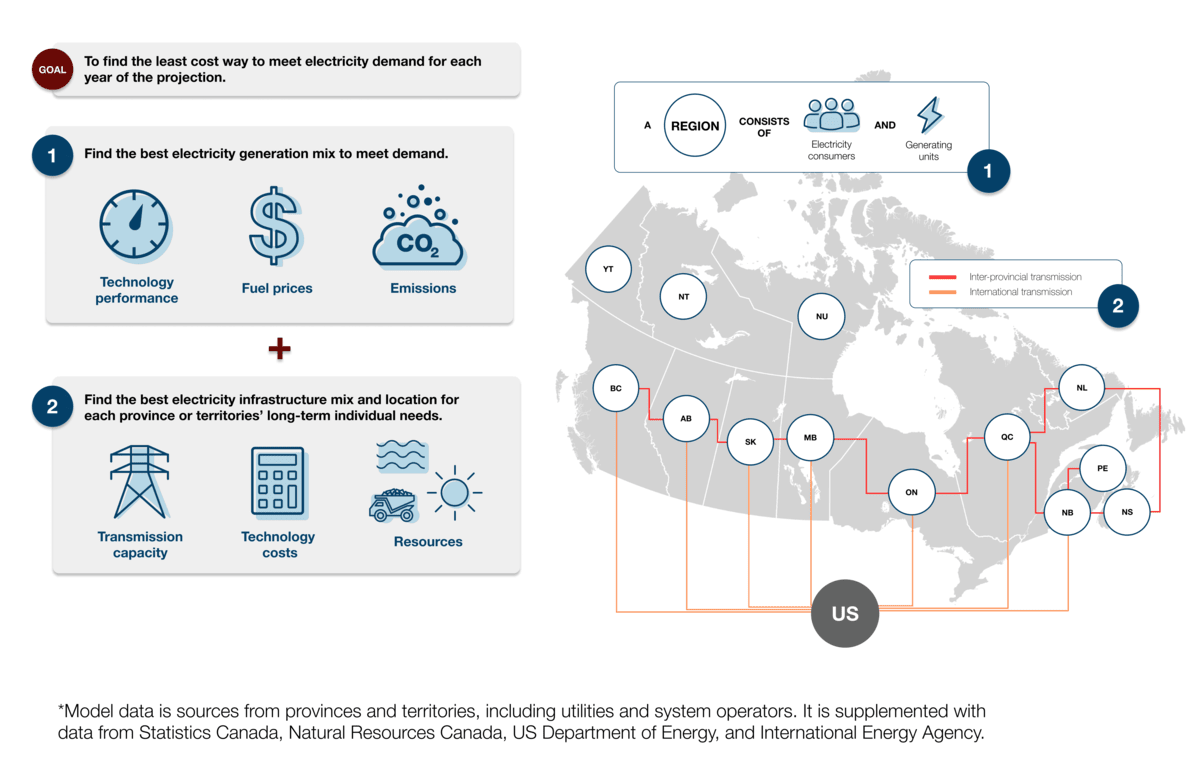
The Electricity model simulates how future electricity demand could be met. The Electricity model, PyPSA-Can, is developed by CER staff based on the Python for Power System Analysis (PyPSA) model, an open-source electric power system planning and simulation model. It models electricity generating and storage units, electricity transmission infrastructure, energy resource availability, electricity demand, and applicable regulations. The model simulates the operation of electric power systems at hourly intervals.
The model has two main components to simulate electricity supply:
Additional information about PyPSA is available.
Source: CER
Text Alternative: The infographic displays a simplified version of how the Electricity model works. The goal of the model is to find the least cost way to meet electricity demand. The model finds the optimal fuel mix in each projection year to meet demand, including costs, prices, and emission generation. It also finds the best generating unit type and location for each province or territory’s individual needs, subject to geographic constraints and resource limits. A map of Canada displays inter-provincial and international transmission corridors. The corridors connect to regional nodes aligned with, where applicable,the distinct provincial and territorial power systems in Canada
| Input | Source and description Values in bold refer to an input that comes from another section of the Energy Futures Modeling System (Figure MS.1). |
|---|---|
| Electricity demand | Hourly end-use electricity demand is obtained from the Energy Demand and Emissions model, as is annual electricity demand to operate direct air capture facilities. Electrolysis hydrogen production demand is obtained from the Hydrogen model. |
| Fuel prices | Input fuel prices are consistent with a scenario’s assumptions (and used in the Energy Demand and Emissions Model), as well as cost trends from the, Bioenergy model, and the Hydrogen model. |
| Policies | Canadian climate and energy policies are Assumptions. These can vary by scenario (See Appendix 1 in Canada’s Energy Future 2026 for details). |
| Technology characteristics | Technology characteristics, such as costs and efficiency, are Assumptions. The values are based on various publicly available sources and modified based on assumptions and Macroeconomic projections, to reflect the Canadian energy economy. The values vary by scenario (See Appendix 2 in Canada’s Energy Future 2026 for details and references). |
| Reliability constraints | These are assumptions based on engineering requirements published by the North American Electric Reliability Corporation (NERC) and provincial and territorial utilities. |
| Cogeneration | Cogeneration operational limits are set in two ways depending on the asset: 1) assumptions based on observed historical behaviour and 2) operational limits that align with cogeneration operations in the oil sands module of the Crude Oil model. |
| Resource availability | Resource availability estimates for wind and solar energy are based on European Centre for Medium-Range Weather Forecasts Reanalysis data version 5 (ERA5) weather data and is further processed through CER variable renewable models. Resource availability data for bioenergy is from the Bioenergy model. Other resource data is collected from various publicly available sources, as needed. |
| Output | Description and linkages with other models in the Energy Futures Modeling System Values in bold refer to an output that is a key input to another model in the Energy Futures Modeling System. |
|---|---|
| Electricity capacity & generation | Installed electricity capacity and generation by province and territory, by projection year, and by technology. Projections are available in the Canada’s Energy Future dataset. |
| Transmission capacity and utilization | Interprovincial transmission capacity by transmission corridor and electricity interchanges at annual resolution. Projections are available in the Canada’s Energy Future dataset. |
| Electricity costs | Average cost of power generation at annual resolution by province and territory are used in the Energy Demand and Emissions model to calculate end-use electricity prices. |