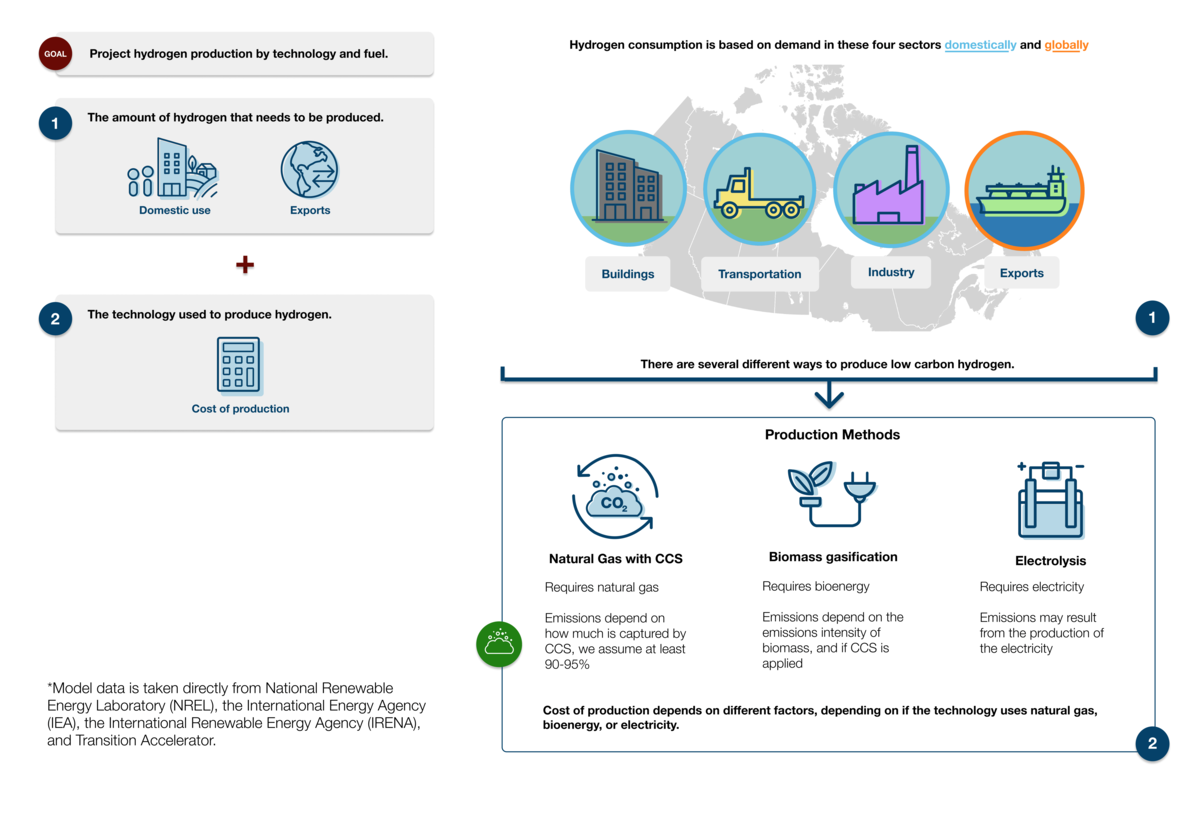
The Hydrogen model determines low and non-emitting hydrogen production by technology type, based on domestic demand and export assumptions. The model is developed by CER staff based on the sector-coupled module of the Python for Power System Analysis (PyPSA) model—an open source, electric power system planning and simulation model. The production technology choice is largely based on relative costs of the technology. Costs are based on the specific characteristics of each production technology, including capital costs, fuel use, capacity, access to carbon sequestration (if applicable), and emissions profiles. The model determines the least costly combination of these technologies needed to meet provincial hydrogen demand and export assumptions in each year of the projection period.
Additional information about PyPSA is available.
Source: CER
Text Alternative: This infographic shows an overview of the hydrogen supply model. Production costs for each technology help determine the market share for each production technology (natural gas with CCS, bioenergy, and electrolysis). Cost of production depends on different factors, depending on the technology.
| Input | Source and description Values in bold refer to an input that comes from another section of the Energy Futures Modeling System (Figure MS.1). |
|---|---|
| Domestic Hydrogen demand | The Energy Demand and Emissions model provides provincial hydrogen demands. This sets how much hydrogen each province needs to produce in each year of the projection period. |
| Hydrogen exports | Hydrogen exports are Assumptions. These can vary by scenario (See the Hydrogen results section in Canada’s Energy Future 2026 for more details). For each region, total hydrogen demand is the sum of domestic demand and assumed exports. |
| Fuel prices |
The cost of feedstock fuels is a key input for investment decisions in natural gas-based and biomass-based hydrogen production pathways. Natural gas and biomass prices are applied at the provincial or territorial level, reflecting regional differences in supply and access across Canada. For grid-connected electrolysis, the cost of purchasing electricity from the provincial grid is a primary cost driver. The model uses provincial marginal electricity prices from the Electricity model. |
| Technology characteristics | Technology parameters, such as costs and efficiency, are based on various publicly available sources and updated to reflect Canadian energy economy conditions and the Macroeconomic model. The values can vary by scenario (See Appendix 2 in Canada’s Energy Future 2026 for details and references). |
| Resources | The model uses wind and solar capacity factors that can vary by year and province and territory. Biomass resource availability is similarly province and territory specific, reflecting the geographic distribution of feedstock supplies across Canada. |
| Policies | Canadian climate and energy policies are Assumptions. These can vary by scenario (See Appendix 1 in Canada’s Energy Future 2026 for details). |
| Output | Description and linkages with other models in the Energy Futures Modeling System Values in bold refer to an output that is a key input to another model in the Energy Futures Modeling System. |
|---|---|
| Hydrogen production | Hydrogen production for each region, by production technology, for each year in the projection period. This data is available in the Canada’s Energy Future dataset. |
| Hydrogen costs | Cost of hydrogen production by region and technology. |
| Dedicated wind and solar build-out | For electrolysis production powered by dedicated renewable generation, the model outputs optimal installed capacities of wind and solar for each province and territory for each projection year. |
| Emissions | The model reports CO2 emissions associated with hydrogen production in each province and territory and projection year. |