Based on our oil price assumptions and other factors, like carbon pricing and technological improvements, the Crude Oil model provides crude oil production projections for all producing regions and types of crude in Canada. It includes an oil sands module, a non-oil sands deliverability module for western Canada, and analysis of other regions in Canada including east coast offshore. The Crude Oil model is developed by CER staff.
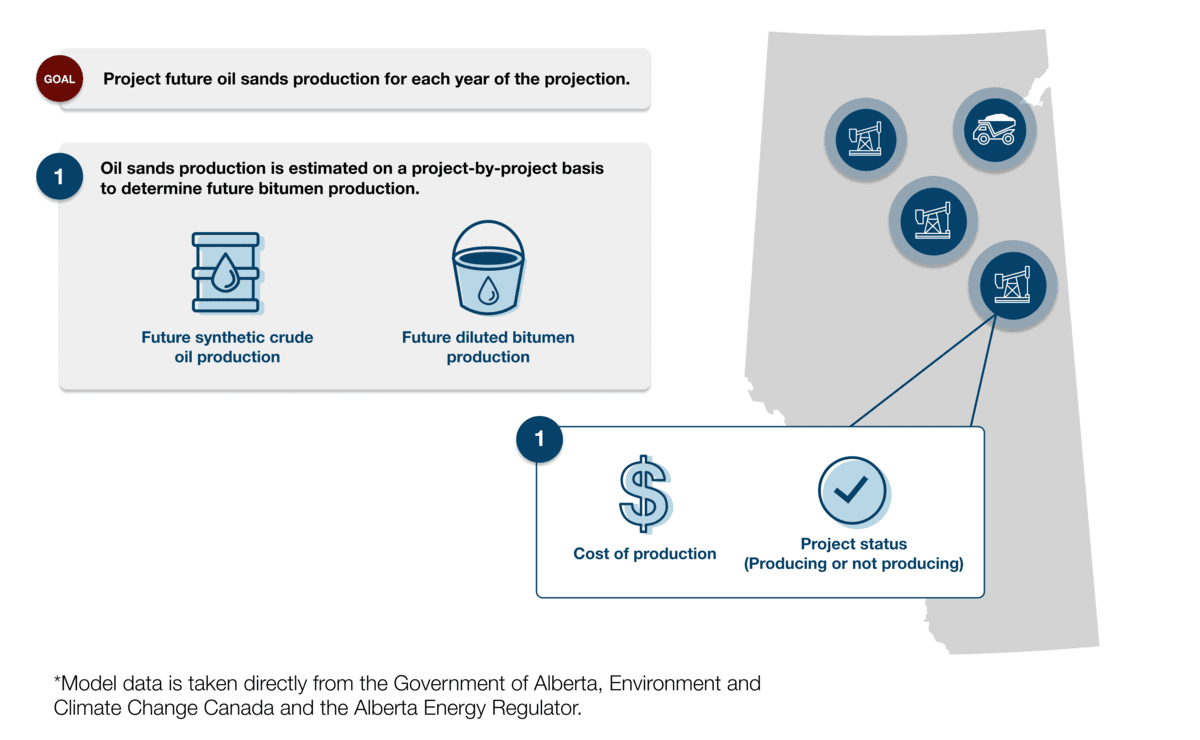
Oil sands production (Figure O.1): The oil sands module compiles historical oil sands production and projects future oil sands production on a project-by-project basis. Historical production data, plans announced by producers, and industry and government consultations, are used to determine which new oil sands projects or expansions are most likely to be completed. Facility-level cost data is used to estimate the profitability of existing projects, future (new) projects, and expansions of both existing and new projects. This information informs the oil sands production projections, along with assumed global and local oil and natural gas prices, and climate policies.
Source: CER
Text Alternative: The infographic provides a simplified visual overview of the oil sands module. The goal of the module is to project total oil sands production for each year of the projection. Oil sands production is estimated on a project-by-project basis to determine future bitumen production, as well as future synthetic crude oil production and future diluted bitumen production. The module breaks each project down into cost of production and status (producing or shut in).
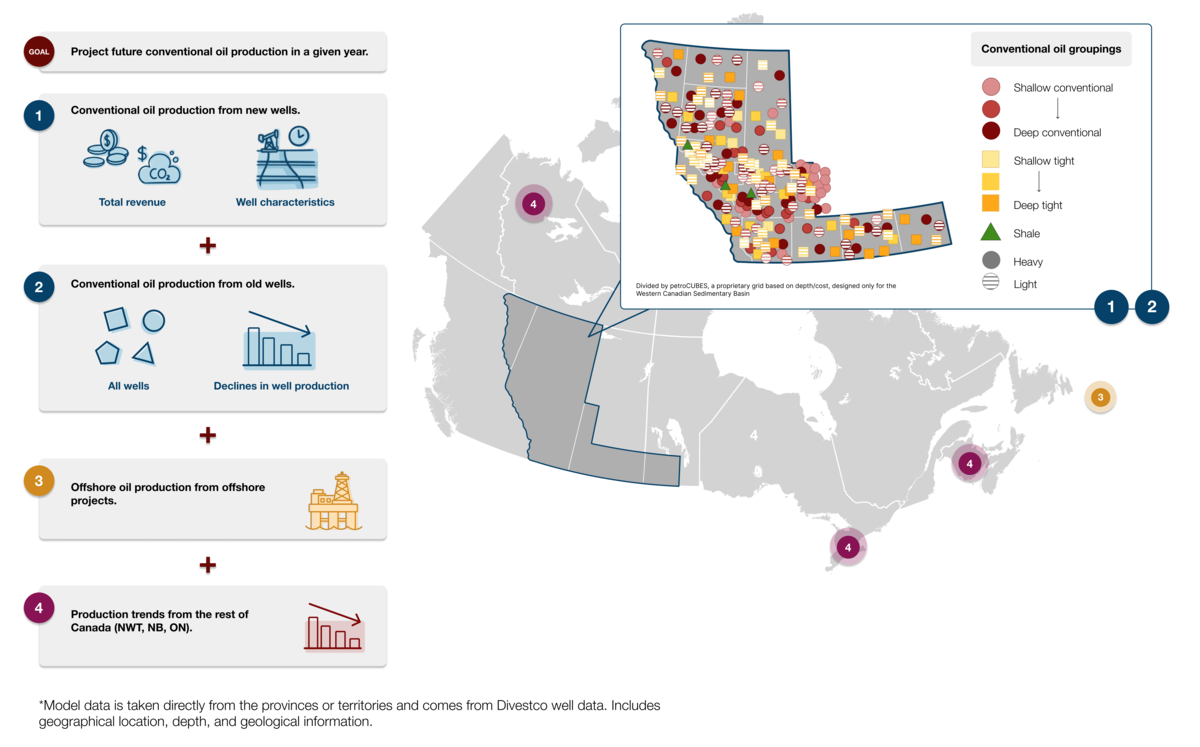
Conventional, tight, and shale oil production (Figure O.2): The module that projects Western Canadian conventional, tight, and shale oil production estimates the capacity of existing and future wells to produce oil (outside of the oil sands). The module starts with detailed data on existing wells. Future projection is determined by declines in existing wells, as well as investment in future production. Future production investments are a function of profitability in the sector (which is heavily influenced by a given scenario’s oil price assumptions), well economics, and projected changes to the production profiles of future wells. Production projections for other regions (Northwest Territories, New Brunswick, Ontario) is based on historical trends.
Newfoundland and Labrador offshore oil production: Newfoundland and Labrador offshore oil production has historically come from five major fields: Hebron, Hibernia, North Amethyst, Terra Nova, and White Rose. Total production is calculated on a field-by-field basis based on company reports and data provided by the Canada-Newfoundland and Labrador Offshore Energy Regulator. Production can be added to existing fields in future time periods based on announcements from operators. New offshore oil fields can be added to the projections when there are strong indicators development will go ahead when considered against other assumptions in the scenario, like oil prices.
Source: CER
Text Alternative: The infographic displays a simplified explanation of the module used to project total Canadian conventional, tight, shale, and offshore oil production for each year of the projection. The module components include:
| Input | Source and description Values in bold refer to an input that comes from another section of the Energy Futures Modeling System (Figure MS.1). |
|---|---|
| Oil price | Oil prices are a key driver of production because they determine how much revenue producers will receive per barrel of production. Oil price assumptions are consistent with each scenario’s Assumptions. Values are adjusted with exchange rate and inflation values based on the Macroeconomic model. |
| Fuel prices | Fuel prices are consistent with each scenario’s Assumptions. Prices for Electricity, Bioenergy, and Hydrogen are based on the costs coming out of those models. Natural gas prices are consistent with each scenario’s Assumptions. Values are adjusted with exchange rate and inflation values based on the Macroeconomic model. |
| Technology characteristics | Technology characteristics, such as costs and efficiency, are Assumptions. The values are based on various publicly available sources and can vary by scenario. |
| Producer and investor behaviour | Factors related to corporate behavior and external uncertainty can interact with the effects of other assumptions, like oil prices, to influence production growth (See “Accounting for producer and investor behaviour in production outlooks” in Canada’s Energy Future 2026 for more information). |
| Policies | Canadian climate and energy policies are Assumptions. These can vary by scenario (See Appendix 1 in Canada’s Energy Future 2026 for details). |
| Historical facility and well data | Oil sands module data comes from the Alberta Energy Regulator, Environment and Climate Change Canada, and the Government of Alberta. Conventional, tight, and shale oil module data comes from Divestco well data, as well as provincial production statistics. The offshore projections use data provided by the Canada-Newfoundland and Labrador Offshore Energy Regulator. |
| Output | Description and linkages with other models in the Energy Futures Modeling System Values in bold refer to an output that is a key input to another model in the Energy Futures Modeling System. |
|---|---|
| Crude oil production |
Oil production by region and type, as published in the crude oil production tables in the Canada’s Energy Future dataset, comes from the Crude Oil Model. The Energy Demand and Emissions model uses crude oil production to project energy use and emissions for the oil and gas sector. Crude oil production also informs growth trends for each scenario’s Macroeconomic projection. |
| Carbon captured via Carbon Capture Utilization and Sequestration (CCUS) | The amount of carbon dioxide (CO2) captured in oil sands operations with CCUS technology is used by the Energy Demand and Emissions model to inform the oil and gas sector’s GHG emission projections. |
| Cogeneration | The Electricity model uses information from the Oil Sands module in the development of electricity supply projections from the industrial sector. |