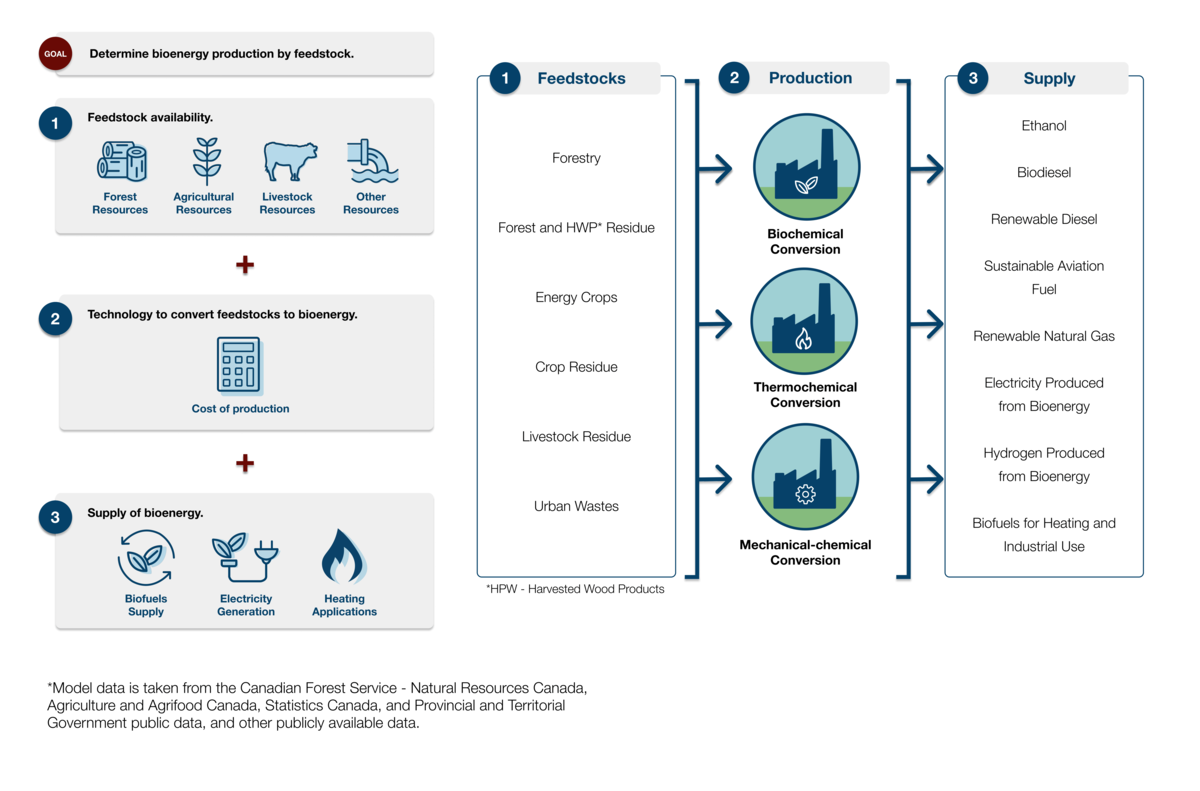
The Bioenergy model estimates bioenergy supply by considering more than 30 different biomass feedstocks and optimizing their use across multiple bioenergy fuel types in each province and territory. The choice of feedstock for each bioenergy type depends on several factors, including feedstock suitability and availability, biofuel demand and prices, preprocessing requirements, land-use needs, and production technologies. The Bioenergy model links three key elements: feedstocks, conversion technologies, and energy demand. For each modeling period, the model calculates the cost and performance of numerous bioenergy pathways that convert available biomass into energy products. These pathways are evaluated, and feedstocks are allocated based on economic performance and their ability to meet demand. This assessment accounts for factors such as production costs, land availability, fuel prices, and policy incentives. Supply allocation continues until physical limits—such as biomass availability or land constraints—are reached. The model is developed by CER staff.
Source: CER
Text Alternative: This infographic displays a simplified version of the CER Bioenergy model. It accounts for energy demand across multiple types of bioenergy, including biodiesel, renewable diesel, ethanol, renewable natural gas, and electricity and hydrogen produced from biomass. The model includes more than 30 different biomass feedstocks (summarized into 6 main groupings, as shown in the graphic) and optimizes how these feedstocks are allocated to various bioenergy types in each province. Feedstock choices depend on several factors, such as suitability and availability, biofuel demand and prices, preprocessing requirements, land use needs, and production technologies.
| Input | Source and description Values in bold refer to an input that comes from another section of the Energy Futures Modeling System (Figure MS.1). |
|---|---|
| Bioenergy demand | Bioenergy demand for ethanol, biodiesel, renewable diesel, renewable natural gas, sustainable aviation fuels, and biofuels used for heating and other uses from the Energy Demand and Emissions model, electricity from bioenergy from the Electricity model, hydrogen from bioenergy from Hydrogen model. |
| Fuel prices | Fuel prices are consistent with each scenario’s Assumptions. Prices for Electricity, and Hydrogen are based on the costs from those respective models. Values are adjusted with exchange rates and inflation values from the Macroeconomic model. |
| Feedstock availability | Forestry and harvested wood products residue, and firewood data from Canada Forestry Services, crop residue data from Biomass Inventory Mapping and Analysis Tool (BIMAT), and province and territory governments, livestock residue data from Statistics CanadaFootnote 1, and other publications, urban waste data from various sources, including Statics Canada and other publications. |
| Policies | Canadian climate and energy policies are Assumptions. These can vary by scenario (See Appendix 1 in Canada’s Energy Future 2026 for details). |
| Technology characteristics | Technology characteristics, such as costs and efficiency, are Assumptions. The values are based on various publicly available sources and modified based on assumptions and the Macroeconomic projections to reflect the Canadian energy economy. The values can vary by scenario (See Appendix 2 in Canada’s Energy Future 2026 for details and references). |
| Output | Description and linkages with other models in the Energy Futures Modeling System Values in bold refer to an output that is a key input to another model in the Energy Futures Modeling System. |
|---|---|
| Bioenergy production | Bioenergy production and supply characteristics, including supply feedstock mix, land used, and technology pathways used. |
| Bioenergy costs | Cost of producing each bioenergy type. Bioenergy costs are a key input for the Energy Demand and Emissions model, Electricity model, and Hydrogen model. |
| Biomass/Bioenergy availability | Determined based on feedstock availability, planned capacity additions, and current market dynamics. Biomass availability are key inputs for the Electricity model, and Hydrogen model. Bioenergy availability also helps set capacity limits in the Energy Demand and Emissions model. |