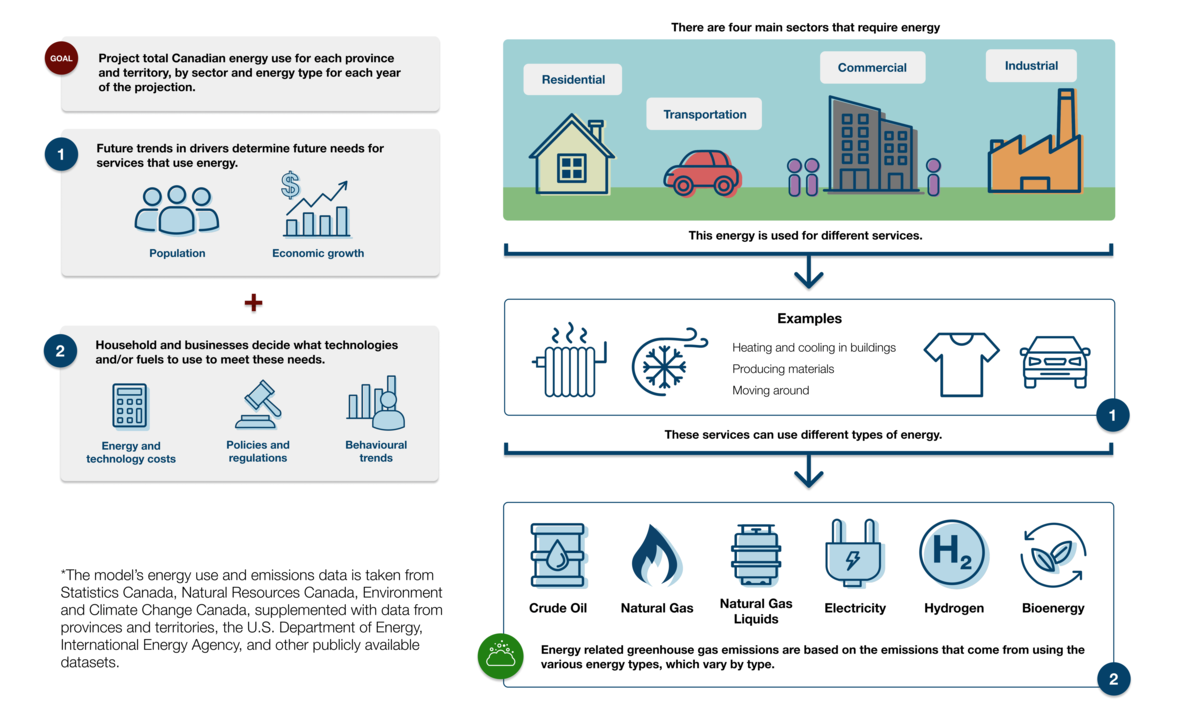
The Energy Demand and Emissions model projects energy use in Canada for various fuel types, across all Canadian provinces and territories and economic sectors (Figure ED.1). The model projects energy-related greenhouse gas (GHG) emissions based on these energy demand projections.
The Canada’s Energy Future 2026 energy demand projections are created using the ENERGY 2020 model. ENERGY 2020 is a hybrid energy-economy model that simulates how technologies that use energy change over time in response to many factors, including economic activity, energy prices, household and business decision-making, and climate policy. In the model, energy demand is a consequence of households and businesses using energy consuming technologies to satisfy their needs. In each sector of the economy energy demand is tied to an economic “driver” that represents a sector’s activity, such as floor space for residential and commercial buildings, industrial products in the industrial sector (e.g., tonnes of steel for the steelmaking sector) and kilometres travelled in the transportation sector. As economic drivers and types of energy technologies selected by households and businesses change over time, so do the energy requirements of the system.
Additional information about ENERGY 2020 is available.
Source: CER
Text Alternative: The infographic displays the steps and components in the Energy Demand model. The goal of the model is to project total Canadian energy use for each province and territory, by sector and energy type for each year of the projection. The model analyses future trends, which determine future needs for services that use energy, such as population and economic growth. It also analyses how factors like energy and technology costs, policies and regulations, and human behaviour trends impact how households and businesses decide what technologies and fuels they will use to meet these needs.
| Input | Source and description Values in bold refer to an input that comes from another section of the Energy Futures Modeling System (Figure MS.1). |
|---|---|
| Economic drivers | Economic drivers, such as gross domestic product, population, and industry-specific growth, come from the Macroeconomics section of the modeling system |
| Fuel prices | Fuel prices are consistent with each scenario’s Assumptions. Prices for Electricity, Bioenergy, and Hydrogen are based on the costs coming out of those models. Values are adjusted with exchange rates and inflation values from the Macroeconomic model. |
| Technology characteristics | Technology characteristics, such as costs and efficiency, are Assumptions. The values are based on various publicly available sources and can vary by scenario (See Appendix 2 in Canada’s Energy Future 2026 for details and references). |
| Policies | Canadian climate and energy policies are Assumptions. These can vary by scenario (See Appendix 1 in Canada’s Energy Future 2026 for details). |
| Crude oil and natural gas production | The Crude Oil and Natural Gas production models provide future production levels. Oil and natural gas production are key drivers for determining energy use and emissions from the upstream oil and natural gas sector. |
| Other key assumptions | Additional Assumptions that are important for the energy demand and emissions model include LNG export assumptions and data centre electricity use. |
| Historical energy demand and emissions data | Historical energy demand and emissions data is primarily sourced from Statistics Canada (Table 25-10-0029-01), Environment and Climate Change Canada’s annual National Inventory Report, and Natural Resources Canada’s Comprehensive End-use Database. |
| Output | Description and linkages with other models in the Energy Futures Modeling System Values in bold refer to an output that is a key input to another model in the Energy Futures Modeling System. |
|---|---|
| Energy demand |
Energy demand by fuel and sector, as published in the End-use Demand tables in the Canada’s Energy Future dataset. Electricity demand is a key input into the Electricity model. Annual demands from ENERGY2020 are converted to hourly demands for each year of the projection with our Electricity Demand Profile Module. The CER’s load-shaping module converts the annual projections into hourly electricity demand profiles covering all analysis years in the outlook. The module splits annual electricity demand into hourly intervals based on a variety of sources including: temperature data consistent with the solar resource data used in the Electricity model, hourly load shapes for the United States (U.S.) by end-use from the National Renewable Energy Laboratory Electrification Futures study and various academic and institutional studies. The Energy Demand and Emissions model supplies hydrogen demand to the Hydrogen model, and bioenergy demand by type (e.g. ethanol, renewable diesel, biomass, etc.) to the Bioenergy model. |
| GHG Emissions | GHG emission projections for most sectors, as published in the GHG Emissions tables in the Canada’s Energy Future dataset. |
| End-use Prices |
End-use prices by sector, as published in the End-use Prices tables in the Canada’s Energy Future dataset. End-use prices, which influence energy demand projections, are consistent with a scenario’s oil and natural gas price Assumptions as well as production costs from the Electricity, Hydrogen, and Bioenergy models, as well as scenario Assumptions. |