
Preparatory documents for CEO appearance before the House of Commons Standing Committee on Natural Resources - April 23, 2026
Topic: “Main Estimates 2026-27”
Table of Contents
- OPENING REMARKS (Bilingual)
- SCENARIO NOTE
- HOUSE OF COMMONS STANDING COMMITTEE ON NATURAL RESOURCES (RNNR): BACKGROUND and COMMITTEE PROFILE
- CER SUMMARY STATISTICS
- KEY BRIEFINGS
- A) Dashboard of Financials
- B) Main Estimates 2026-27 (CER extract)
- C) Departmental Results Framework Performance Summary Results by Core Responsibility
- D) Large Companies (Proportional Levies) — Primary Cost Recovery Payers
- E) CER Allocation and Cost Recovery
- F) CER Grants and Contributions
- G) Status of Major Applications Before the CER
- H) Red Tape Review
- I) Regulatory Optimization and Efficiency Efforts
- J) Building Canada Act
- K) Previous major projects that did not proceed
- L) CER Regulatory Requirements and Timing Statistics
- ENVIRONMENTAL SCAN
OPENING REMARKS (Bilingual)
Check against delivery / L’allocution fait foi
INTRODUCTION
Good afternoon committee members. Thank you for inviting the Canada Energy Regulator to appear as part of your study on Main Estimates.
My name is Tracy Sletto, and I am the Chief Executive Officer at the CER.
I am joined today by Jason Reid, Executive Vice President of People, Innovation, and Results and Chief Financial Officer, and Chris Loewen, Executive Vice President, Regulatory.
In my opening remarks, I will provide a brief overview of the CER’s mandate and 2026-27 Main Estimates, including how our funding is allocated and what it supports in practice.
LAND ACKNOWLEDGEMENT
I would like to begin by acknowledging that we are meeting on the unceded, ancestral, and traditional territory of the Algonquin Anishinaabe [Ah-nish-naw-bae] Nation, who have lived on and cared for the land now known as Ottawa since time immemorial.
[pause]
CER MANDATE
Avant de parler de notre budget principal des dépenses, j’aimerais donner un bref aperçu de la Régie.
La Régie de l’énergie du Canada est l’organisme qui réglemente les infrastructures énergétiques de manière à prévenir les préjudices et à s’assurer que l’énergie est acheminée de manière sécuritaire, fiable, concurrentielle et durable sur le plan de l’environnement partout au Canada.
Cela s'applique à tout pipeline qui traverse une frontière provinciale ou internationale, et aux lignes électriques qui traversent une frontière internationale.
Notre mandat comprend aussi un volet économique important, par le truchement de la réglementation financière qui opère par la surveillance des droits et tarifs pipeliniers.
La Régie réglemente également les exportations de produits énergétiques et l’exploration de pétrole et de gaz dans certaines régions du Nord et dans les zones extracôtières du Canada.
Elle a aussi comme mandat de produire de l’information sur les questions qui touchent l’énergie.
Elle fournit enfin des données et des analyses qui éclairent la prise de décisions et alimentent le dialogue sur l’énergie au Canada.
Notre travail est entièrement accompli dans le respect des droits et des intérêts des Premières Nations, des Inuits et des Métis. Dans tout ce que fait la Régie, la surveillance de la sécurité et de l’environnement est toujours à l’avant-plan.
[pause]
HIGHLIGHTS OF CER’S MAIN ESTIMATES 2026-27
The CER’s operations are funded from parliamentary appropriation but the Government of Canada recovers approximately 95% of the CER’s costs from regulated industry.
I would now like to give context on the CER’s Main Estimates for 2026-27. The CER’s planned spending is $119.4 million allocated across our core responsibilities:
Safety and Environment Oversight accounts for $30.7 million, which supports setting and enforcing our expectations for regulated companies across the full lifecycle of energy facilities.
Energy Adjudication receives $29.6 million, supporting the CER Commission’s decision-making on applications, hearings, and regulatory processes.
Our Engagement core responsibility is funded at $11.0 million, enabling engagement and consultation with Indigenous Peoples and stakeholders nationally and regionally, through open and responsive dialogue.
Energy Information receives $5.3 million, to support collecting, monitoring, analyzing, and publishing energy information for Canadians.
Lastly, Internal Services, which enables the delivery of the four core responsibilities, with $42.9 million dedicated to management oversight, communications, legal, financial and human resources management and IT functions.
Within these totals, transfer payments represent $10.6 million of the CER’s budget. These funds are used specifically to support Indigenous Peoples and stakeholder participation in CER activities, including adjudication, engagement, and safety and environment oversight.
As indicated in our 2026–27 Departmental Plan, our core responsibilities are guided by four strategic priorities, which are: to foster trust and confidence by effectively delivering on our mandate; to enhance Canada’s global competitiveness through leadership in regulatory innovation and best practices; to advance Reconciliation and implement the United Nations Declaration on the Rights of Indigenous Peoples; and to prepare for the energy future by offering energy expertise.
Through 2026-27, we will continue to modernize our regulatory framework and streamline our processes. This includes initiatives from the CER’s Red Tape Review Report, such as launching a new digital portal, significantly reducing decision timelines for routine pipeline applications, removing outdated and unnecessary reporting requirements, and updating the Onshore Pipeline Regulations.
CONCLUSION
In closing, I want to thank you for giving us the opportunity to speak with you today, and we look forward to your questions.
SCENARIO NOTE
APPEARANCE BEFORE THE HOUSE OF COMMONS STANDING COMMITTEE ON NATURAL RESOURCES
THURSDAY, APRIL 23, 2026
The House of Commons Standing Committee on Natural Resources (RNNR) has invited the CER to participate in their study of the Main Estimates, 2026-2027.
Natural Resources Canada (NRCan)
- Greg Orencsak, Deputy Minister of Energy and Natural Resources
- Jeff Labonte, Associate Deputy Minister (TBC)
- Francis Brisson, Assistant Deputy Minister and Chief Financial Officer
- Erin O'Brien, Assistant Deputy Minister, Fuels Sector
- Glenn Hargrove, Assistant Deputy Minister, Canadian Forest Service
- Claudine Pagé, A/Assistant Deputy Minister, Lands and Minerals Sector
- Kimberly Lavoie, Assistant Deputy Minister, Nòkwewashk
- Drew Leyburne, Assistant Deputy Minister, Energy Systems Sector
- Debbie Scharf, Assistant Deputy Minister, Strategic Policy and Innovation Sector
- Frank Des Rosiers, Assistant Deputy Minister, Energy Efficiency and Technology Sector
- Rinaldo Jeanty, Assistant Deputy Minister, Geoscience and Earth Monitoring Sector
Canada Energy Regulator (CER)
- Tracy Sletto, Chief Executive Officer
- Jason Reid, Executive Vice President, People, Innovation, and Results & Chief Financial Officer
- Chris Loewen, Executive Vice President, Regulatory
Canadian Nuclear Safety Commission (CNSC)
- Stéphane Cyr, VP, Corporate Services Branch and Chief Financial Officer
- Colin Moses, VP, Regulatory Affairs Branch and Chief Communications Officer
Context
- On Thursday, March 26, 2026, the committee adopted the following motion:
- That the committee undertake a study of the Main Estimates, 2026-2027, and invite the following witnesses, along with the appropriate officials from Natural Resources Canada:
- The Minister of Energy and Natural Resources;
- Greg Orencsak, Deputy Minister of Energy and Natural Resources;
- Tracy Sletto, Chief Executive Officer, Canada Energy Regulator;
- Pierre Tremblay, President and Chief Executive Officer, Canadian Nuclear Safety Commission.
- That the committee undertake a study of the Main Estimates, 2026-2027, and invite the following witnesses, along with the appropriate officials from Natural Resources Canada:
Committee Procedure
- You will have 5 minutes for your opening remarks. The committee will then proceed to questions and answers. In the House of Commons, the questioning tends to be more formal than in the Senate. Time limits are strictly enforced and Members will engage in political maneuvering.
- Following remarks, the committee will proceed with rounds of questions. Round one: CPC, LPC and BQ – six minutes each; all subsequent rounds: CPC and LPC – five minutes each; BQ – 2.5 minutes. In total, approximately four rounds of questions can be expected in the hour.
- Witnesses scheduled to appear before the Committee who wish to familiarize themselves with the general committee process may consult the Guide for Witnesses Appearing before House of Commons Committees.
Committee Environment & Context
- RNNR has a total membership of 10 Members of Parliament. The committee is composed of 5 Liberals (including the Chair), 4 Conservatives, and 1 Bloc Québécois. A profile of the committee, with bios and intel on each member, has been provided.
- Discussions around important policy issues are typically quite heated. CER witnesses should expect for MPs to use this study to touch on a range of issues related to energy policy, Canadian sovereignty, regulatory policy, natural resource development, economic growth, the environment and climate change, and Reconciliation with Indigenous Peoples.
HOUSE OF COMMONS STANDING COMMITTEE ON NATURAL RESOURCES (RNNR): BACKGROUND and COMMITTEE PROFILE
Background:
The House of Commons Standing Committee on Natural Resources may examine issues related to the four industrial sectors that constitute the mandate of the Department of Natural Resources Canada: the energy sector, the forest sector, the minerals and metals sector and the earth sciences sector. In addition to considering bills referred to it, the committee focuses on expenditures and activities of the organizations that are part of the Natural Resources portfolio:
- one Crown Corporation: Atomic Energy of Canada Limited;
- two independent regulators: the Canadian Nuclear Safety Commission and the Canada Energy Regulator;
- two offshore petroleum and energy boards: the Canada-Newfoundland and Labrador Offshore Petroleum Board and the Canada-Nova Scotia Offshore Energy Regulator; and
- two boards that report to the Minister as required: the Northern Pipeline Agency and the Energy Supplies Allocation Board.
Committee Members:
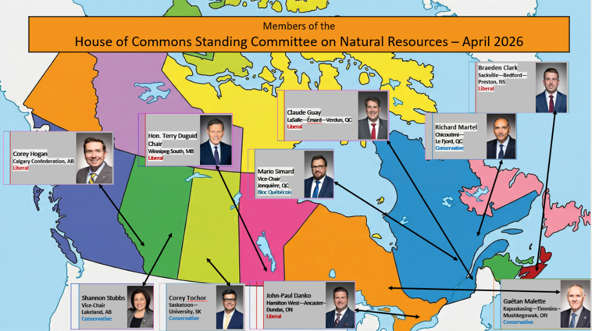
Projects Mentioned by Committee Members
- Shannon Stubbs (CPC)
- Trans Mountain Expansion Project
- The Northern Gateway Pipeline
- Energy East Pipeline
- North Coast Transmission Line (NCTL)
- Corey Tochor (CPC)
- Trans Mountain Expansion Project
- The Northern Gateway Pipeline
- LNG Canada
- Energy East
- Richard Martel (CPC)
- LNG Canada
- Gaétan Malette (CPC)
- Trans Mountain Expansion Project
- Mario Simard (BQ)
- Trans Mountain Expansion Project
- The Northern Gateway Pipeline
- Energy East
- Keystone XL
- LNG Canada
- Coastal GasLink
- John-Paul Danko (Lib)
- Trans Mountain Expansion Project
- Claude Guay (Lib)
- Cedar LNG
- LNG Canada
- Corey Hogan (Lib)
- Trans Mountain Expansion Project
- Braeden Clark (Lib)
- N/A
- Mentioned by non-regular members of committee
- Powell River Energy Inc.
COMMITTEE PROFILE

Shannon Stubbs
Riding: Lakeland, AB
Political Party: Conservative
Profession: Public Servant, MLA
Elected to Parliament: October 2015
Shadow Minister for Natural Resources (Critic)
General Information:
Ms. Stubbs graduated with Honours/B.A. in Political Science and English from the University of Alberta. She interned in Ottawa for the Leader of the Official Opposition, Preston Manning, and worked in the constituency office of MP Deborah Grey. Ms. Stubbs worked in the field of public relations, where she advocated on behalf of not-for-profit organizations, charities, educational institutions, pharmaceutical companies, and the oil and gas sector. She worked in the Oil Sands Business Unit of the Alberta Ministry of Energy, and she eventually moved on to the International Offices and Trade Division of the Ministry of Economic Development. She provided policy development, research and communications support, led the organization of a series of public-private workshops on transportation infrastructure, labour needs, royalties and taxation, First Nations relations, and environmental stewardship in Alberta’s oil sands regions, and hydrocarbon upgrading development. Additionally, she co-led an international marketing and advocacy project for the oil sands and heavy oil technology, supply and services businesses.
She served as Danielle Smith's Chief of Staff from 2010–12 and the party's Director of Legislative Affairs from 2012–14. Ms. Stubbs has served as the federal MP for Lakehead since October 2015. She served as both the Shadow Minister and Deputy Critic for Natural Resources from 2015-19. Prior to her re-appointment to the Natural Resources critic role, she held the CPC critic roles for Rural Economic Development and Rural Broadband, and Public Safety and Emergency Preparedness. Ms. Stubbs has sat on numerous parliamentary committees and was the Vice Chair of the Standing Committees on Natural Resources, Public Safety and National Security, and the Special Select Standing Committee for Pay Equity.
Top Issues: regulatory efficiency, energy project approval, the oil and gas sector, LNG, energy affordability, energy security.

Corey Tochor
Riding: Saskatoon—University, SK
Political Party: Conservative
Profession: Entrepreneur, MLA
Elected to Parliament: October 2019
Associate Shadow Minister for Natural Resources (Nuclear)
General Information: Corey Tochor was elected as a Member of Parliament to represent the federal riding of Saskatoon-University on October 21, 2019. He was re-elected in September 2021 and May 2025. In the 44th Parliament, he served as the Vice-Chair on the Science and Research committee and is currently the Associate Shadow Minister for Natural Resources (Nuclear) for the Conservative Party.
Corey was born and raised in Esterhazy, Saskatchewan and prior to entering politics, was a local Saskatoon entrepreneur who owned and operated Health Conveyance, a communications company that provides electronic messaging in health facilities across the province. Corey graduated with a commerce degree from the U of S with a major in Finance. He had a successful career in sales, e-learning consulting and pharmaceuticals before starting his own business. These experiences have helped Corey become a strong voice for the local Saskatoon business community.
As an active volunteer in his local community, Corey served for many years on the executive of the Kinsmen Club of Saskatoon including on the corporate board for Telemiracle 33, chair of fundraising projects and treasurer of the Kinsmen Activity Place House, a community center supporting Saskatoon’s core.
Top Issues: Nuclear energy development and regulation including disposal, uranium development, climate change and cost of living, renewable energy and fuels development.

Richard Martel
Riding: Chicoutimi—Le Fjord, QC
Political Party: Conservative
Profession: Hockey Coach
Elected to Parliament: June 2018
General Information:
Richard Martel was born in Chicoutimi, QC. He was a successful hockey coach for 21 years in the Quebec Major Junior Hockey League before being elected to the House of Commons in a byelection in 2018. In Parliament, he was the CPC’s associate critic on National Defence, and was named the party’s Quebec lieutenant under the leadership of Erin O’Toole. However, after the CPC failed to make gains in Quebec during the 2021 federal election he lost the Quebec lieutenant role to Alain Rayes.
Top Issues: LNG, Forestry, Critical Minerals.

Gaétan Malette
Riding: Kapuskasing—Timmins—Mushkegowuk, ON
Political Party: Conservative
Profession: Retired Forestry Executive
Elected to Parliament: April 2025
Associate Shadow Minister for Natural Resources (Mining & Forestry)
General Information:
Gaétan Malette was born and raised in Timmins and is a retired forestry executive. He's also had leadership roles on several boards, including as Commissioner of Ontario Northland, an Ontario Crown agency and an economic development engine for Northern Ontario, as well as the Timmins and District Hospital, the francophone health centre, and the Timmins Police Services Board. In addition, he has served as Director of the Canadian Lumber Manufacturers Association, and as a board member of the Nawiinginokiima Forest Management Corporation, a Crown Agency that promotes partnerships between First Nations and communities in Ontario around forest management issues. Mr. Malette was also previously an employee of Domtar from 1998 to 2007. Of note, Domtar was acquired by Asian conglomerate Paper Excellence in 2021.
In the 2025 Ontario provincial election, he was the campaign chair for now MPP and Minister of Mines George Pirie's successful bid.
Top Issues: Forestry, Mining.

Mario Simard
Riding: Jonquière, QC
Political Party: Bloc Québécois
Profession: University Lecturer
Elected to Parliament: October 2019
Natural Resources Critic
General Information:
Mario Simard has been a lecturer in political science and social work at the Université du Québec à Chicoutimi since 2005. He holds a bachelor's and master's degree in political science. Mr. Simard was a political attaché from 2011 to 2015 for the former member for Jonquière – Alma, Claude Patry, who was elected as NDP before transferring to the Bloc Québécois during his mandate. Mr. Simard was elected to the House of Commons in 2019.
Mr. Simard has been the Bloc’s critic of natural resources and a member of the House Committee on Natural Resources since the start of the 43rd Parliament. He has served as the vice-chair of RNNR since 2020.
Top Issues: fossil fuel subsidies, forest sector, carbon pricing, aluminum industry, green hydrogen, Quebec’s clean energy

Hon. Terry Duguid
Riding: Winnipeg South, MB
Political Party: Liberal
Profession: Eco-Business
Elected to Parliament: October 2015
General Information:
Terry Duguid was born and raised in Winnipeg. He holds an Honours B.Sc. in Biology from Carleton University and a Master of Environmental Design (Environmental Science) from the University of Calgary. He has been involved in a variety of eco-business pursuits in the Winnipeg area, including being president of Sustainable Development International, and serving as chairman of the Manitoba Clean Environment. He also served on the Winnipeg City Council from 1989 to 1995, where he served on the city’s Public Works committee.
In Parliament, Mr. Duguid served as Parliamentary Secretary to the Minister of Families, Children, and Social Development in 2015, and as Parliamentary Secretary for the Status of Women in 2017. He was appointed to the Trudeau Cabinet in December 2024 as Minister of Sport, and then to the Carney Cabinet in March 2025 as the Minister of Environment and Climate Change.

John-Paul Danko
Riding: Hamilton West—Ancaster—Dundas, ON
Political Party: Liberal
Profession: Civil Engineer
Elected to Parliament: April 2025
General Information:
John-Paul Danko graduated from McMaster University with a degree in Civil Engineering. He is a licensed professional engineer who worked for 20 years in the private sector designing, building and managing the construction of heavy civil public infrastructure projects. Until his election to the House of Commons in April 2025, from December 2018 Mr. Danko was a city councillor in Hamilton, Ontario where he served as Vice Chair of the City Council’s Public Works standing committee.

Claude Guay
Riding: LaSalle—Émard—Verdun, QC
Political Party: Liberal
Profession: Industrial Engineer
Elected to Parliament: April 2025
General Information:
Claude Guay holds a bachelor's degree in industrial engineering from the École Polytechnique de Montréal. Before being elected to Parliament, he occupied executive roles in a number of IT-related companies, most notably as President of IBM Canada. Most of his experience is related to IT, including research in the use of AI and other technologies in solving business problems. He also stated that efforts need to be made to ensure that Indigenous youth are given the opportunity to learn digital and technological skills so that they can participate in the changing workforce landscape. Despite his IT background, he stated that his priority focus areas as a Parliamentarian will be housing and the local economy.

Corey Hogan
Riding: Calgary Confederation, AB
Political Party: Liberal
Profession: Communications
Elected to Parliament: April 2025
General Information:
Corey Hogan was born in Ottawa, Ontario, but grew up in Calgary, Alberta. He holds a Master of Business Administration (MBA) from the University of Western Ontario. Before being elected to the House of Commons, Mr. Hogan worked as the Senior Associate Vice President of Communications at the University of Calgary and had previously been a deputy minister in the Alberta public service as the head of government communications. Mr. Hogan was elected to the House of Commons during the 2025 federal election as one of two Alberta Liberal MPs and the lone Liberal MP among Calgary ridings.

Braeden Clark
Riding: Sackville—Bedford—Preston
Political Party: Liberal
Profession: Communications, Policy Development, and Government Relations
Elected to Parliament: April 28, 2025
General Information:
Braeden Clark grew up in Bedford, Nova Scotia, where he has strong roots in the community. Prior to his federal election, he worked as a political assistant and in public relations. He was elected to the Nova Scotia House of Assembly in the 2021 provincial general election, representing Bedford South as a member of the Nova Scotia Liberal Party. During his time as an MLA, he served on the Public Accounts Committee and the Law Amendments Committee, and held the role of Official Opposition critic for Housing, Healthcare Redevelopment, Service Nova Scotia, and Youth. He was elected as a Liberal Member of Parliament for Sackville—Bedford—Preston in the 2025 federal election.
In Parliament, Mr. Clark currently serves as a member of the Standing Committee on Natural Resources. He is a member of several parliamentary associations, including the Canadian NATO Parliamentary Association and the Canada-United States Inter-Parliamentary Group.
CER SUMMARY STATISTICS
| Expenditures (Millions) | Staff (FTE) | |
|---|---|---|
| 2022-23 | 112.4 | 571.2 |
| 2023-24 | 113.7 | 570.9 |
| 2024-25 | 131 | 580.2 |
| 2025-26 Forecasted | 125.1 | 581.5 |
| 2026-27 Planned | 119.4 | 559.4 |
| 2022-23 Actual Spending | 2023-24 Actual Spending | 2024-25 Actual Spending | 2025-26 Forecasted Spending | 2026-27 Planned Spending | |
|---|---|---|---|---|---|
| Energy Adjudication | 23.7 21% |
24.2 21% |
28.9 22% |
30.7 25% |
29.6 25% |
| Safety and Environment Oversight | 25.4 23% |
26.1 23% |
32.2 25% |
29.5 24% |
30.6 26% |
| Energy Information | 7.5 7% |
7.4 7% |
9.1 7% |
7.8 6% |
5.3 4% |
| Engagement | 8.5 8% |
9.6 8% |
9.8 7% |
9.7 8% |
11 9% |
| Internal Services | 47.3 42% |
46.4 41% |
51 39% |
47.4 38% |
42.9 36% |
| Total | 112.4 | 113.7 | 131 | 125.1 | 119.4 |
| 2022-23 Actual full-time equivalents |
2023-24 Actual full-time equivalents |
2024-25 Actual full-time equivalents |
2025-26 Forecasted full-time equivalents |
2026-27 Planned full-time equivalents |
|
|---|---|---|---|---|---|
| Energy Adjudication | 121.4 | 120.1 | 117.6 | 123.6 | 122.7 |
| Safety and Environment Oversight | 137.7 | 138.6 | 140.3 | 143 | 144.9 |
| Energy Information | 41.6 | 40.6 | 44.5 | 41 | 36.9 |
| Engagement | 44.8 | 46.2 | 47.3 | 44.6 | 41.2 |
| Internal Services | 225.7 | 225.4 | 230.5 | 229.3 | 213.7 |
| Total | 571.2 | 570.9 | 580.2 | 581.5 | 559.4 |
KEY BRIEFINGS
A) Dashboard of Financials
- 1. Planned spending by core responsibility and for internal services in 2026-27
(This information is presented in the DP 2026-27)
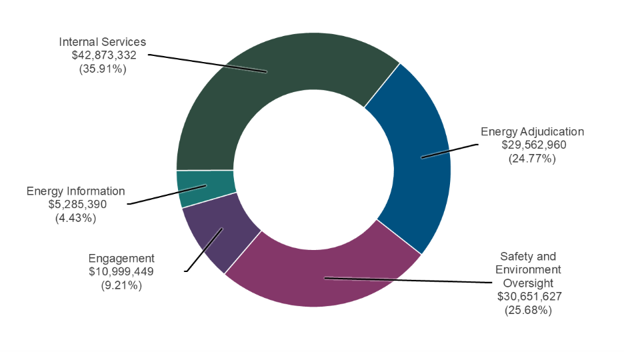
| Core responsibilities and internal services | 2026-27 planned spending | Percentage |
|---|---|---|
| Energy Adjudication | $29,562,960 | 24.77% |
| Safety and Environment Oversight | $30,651,627 | 25.68% |
| Energy Information | $5,285,390 | 4.43% |
| Engagement | $10,999,449 | 9.21% |
| Internal Services | $42,873,332 | 35.91% |
| Total | $119,372,758 | 100% |
- Planned three-year spending on core responsibilities and internal services (dollars)
(This information is presented in the DP 2026-27)
| Core responsibilities and internal services | 2026-27 Planned Spending | 2027-28 Planned Spending | 2028-29 Planned Spending |
|---|---|---|---|
| Energy Adjudication | 29,562,960 | 26,808,652 | 19,670,325 |
| Safety and Environment Oversight | 30,651,627 | 29,456,903 | 24,964,926 |
| Energy Information | 5,285,390 | 5,195,994 | 5,163,215 |
| Engagement | 10,999,449 | 9,669,987 | 5,214,965 |
| Subtotal | 76,499,426 | 71,131,536 | 55,013,431 |
| Internal Services | 42,873,332 | 42,214,569 | 39,546,531 |
| Total | 119,372,758 | 113,346,105 | 94,559,962 |
Comparison of three-year spending plans 2026-27 vs 2027-28:
Variance between 2026-27 planned spending and 2027-28 planned spending
The 2027-28 planned spending is $6.03 million lower than the 2026-27 planned spending primarily related to:
- a decrease of $4.20 million related to Grants and Contributions.
- a decrease of $1.57 million primarily related to Collective Agreement renewal and other compensation adjustments including changes to terms and conditions of service or employment in the federal public administration.
- a decrease of $0.26 million related to employee benefits plan costs.
Variance between 2027-28 planned spending and 2028-29 planned spending
The 2028-29 planned spending is $18.79 million lower than the 2027-28 planned spending primarily related to:
- a decrease of $11.80 million related to Budget 2022 funding for regulatory renewal activities, as well as funding to implement the Impact Assessment Act.
- a decrease of $5.34 million related to Grants and Contributions.
- a decrease of $1.65 million mainly related to employee benefits plan costs.
- 2026-27 Main Estimates: Recent Historical Context
(Not presented in a single document but can be inferred with published information. Internally produced)
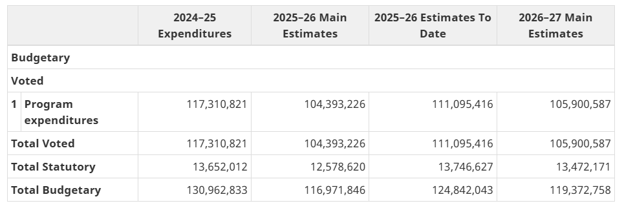
Variance between 2025-26 Main Estimates and 2024-25 Expenditures
The 2025-26 Main Estimates is $13.99 million lower than the 2024-25 actual spending primarily related to:
- a decrease of $7.05 million primarily related to Collective Agreement renewal in FY24-25 and other compensation adjustments including changes to terms and conditions of service or employment in the federal public administration;
- a decrease of $6.84 million related to Budget 2022 funding for regulatory renewal activities, as well as funding to implement the Impact Assessment Act;
- a decrease of $1.07 million mainly related to employee benefits plan costs;
- a decrease of $0.66 million related to Grants and Contributions;
- an increase of $1.23 million mainly related to changes to support evolving organizational priorities and requirements; and
- an increase of $0.40 million related to Budget 2024 funding for Indigenous Advisory and Monitoring Committees.
Variance between 2025-26 Estimates to date and 2025-26 Main Estimates
The 2025-26 Estimates to date is $7.87 million higher than the 2025-26 Main Estimate primarily related to Budget 2025 funding for net-zero energy modeling; innovative data and information management; as well as regulatory experimentation projects.
Variance between 2026-27 Main Estimates and 2025-26 Main Estimates
The 2026-27 Main Estimates is $2.40 million higher than the 2025-26 Main Estimate primarily related to:
- an increase of $4.12 million related to Grants and Contributions;
- an increase of $1.74 million related to Budget 2022 funding for regulatory renewal activities, as well as funding to implement the Impact Assessment Act;
- an increase of $0.69 million mainly related to employee benefits plan costs;
- a decrease of $2.27 million mainly related to changes to support evolving organizational priorities and requirements; and
- a decrease of $1.88 million related to Budget 2024 funding for Indigenous Advisory and Monitoring Committees;
B) Main Estimates 2026-27 (CER extract)
*****The Tables are as presented in the 2026–27 Main Estimates tabled in parliament on 26 February 2026 ****
Canadian Energy Regulator
The Canadian Energy Regulator regulates interprovincial and international pipelines and powerlines, offshore renewable energy projects, oil and natural gas operations in frontier areas, and energy trade.
Additional information can be found in the Canadian Energy Regulator’s Departmental Plan.
| 2024–25 Expenditures | 2025–26 Main Estimates | 2025–26 Estimates To Date | 2026–27 Main Estimates | ||
| Budgetary | |||||
| Voted | |||||
| 1 | Program expenditures | 117,310,821 | 104,393,226 | 111,095,416 | 105,900,587 |
| Total Voted | 117,310,821 | 104,393,226 | 111,095,416 | 105,900,587 | |
| Total Statutory | 13,652,012 | 12,578,620 | 13,746,627 | 13,472,171 | |
| Total Budgetary | 130,962,833 | 116,971,846 | 124,842,043 | 119,372,758 | |
| Operating | Capital | Transfer Payments | Revenues | Total | ||
| Safety and Environment Oversight | 27,951,627 | 0 | 2,700,000 | 0 | 30,651,627 | |
| Energy Adjudication | 23,876,423 | 0 | 5,686,537 | 0 | 29,562,960 | |
| Engagement | 8,814,449 | 0 | 2,185,000 | 0 | 10,999,449 | |
| Energy Information | 5,285,390 | 0 | 0 | 0 | 5,285,390 | |
| Internal Services | 42,873,332 | 0 | 0 | 0 | 42,873,332 | |
| Total | 108,801,221 | 0 | 10,571,537 | 0 | 119,372,758 | |
| 2024–25 Expenditures | 2025–26 Main Estimates | 2026–27 Main Estimates | |
| Grants (Grants are subject to pre-established eligibility and other criteria, and may be required to report on results achieved)Footnote 1 |
|||
| Grants to support Indigenous Peoples and stakeholder participation in CER activities, including adjudication, engagement, and safety and environmental oversight | 1,496,479 | 3,370,890 | 3,728,448 |
| Contributions (Contributions are subject to performance conditions specified in a funding agreement, and must be accounted for and are subject to audit) |
|||
| Contributions to support Indigenous Peoples and stakeholder participation in CER activities, including adjudication, engagement, and safety and environmental oversight | 5,612,820 | 3,081,893 | 6,843,089 |
| 2024–25 Expenditures | 2025–26 Estimates To Date | 2026–27 Main Estimates | |
| Contributions to employee benefit plans | 13,652,012 | 13,746,627 | 13,268,133 |
| Expenditures of revenues pursuant to subsection 29.1(1) of the Financial Administration Act | 0 | 0 | 204,038 |
C) Departmental Results Framework Performance Summary Results by Core Responsibility
| PERFORMANCE MEASURE | TARGET | RESULTS 2023-24 | RESULTS 2024-25 |
|---|---|---|---|
| Number of serious injuriesFootnote 2 and fatalities related to regulated infrastructure. | 0 | 9 | 5 |
| Number of incidents related to regulated infrastructure that harm the environment. | 0 | 26 | 6 |
| Percentage of unauthorized activities on regulated infrastructure that involve repeat violators. | <15% | 11% | 15% |
| PERFORMANCE MEASURE | TARGET | RESULTS 2023-24 | RESULTS 2024-25 |
|---|---|---|---|
| Percentage of adjudication decisions overturned on judicial appeal related to procedural fairness. | 0% | 0% | 0% |
| Percentage of adjudication decisions and recommendations that are made within legislated time limits and service standards. | 100% | 100% | 100% |
| Percentage of surveyed participants who indicate that adjudication processes are transparent. | 75% | 85% | 67% |
| Percentage of surveyed participant fundingFootnote 3 recipients who agree that participant funding enabled their participation in an adjudication process. | 90% | 95% | 100% |
| PERFORMANCE MEASURE | TARGET | RESULTS 2023-24 | RESULTS 2024-25 |
|---|---|---|---|
| Evidence that Canadians access and use CER Energy Information products and specialized expertise, including community-specific information, for knowledge, research, or decision-making. | Narrative* | Target achieved* | Target achieved* |
| Number of opportunities that Canadians have to collaborate and provide feedback on energy information products. | 85 | 231 | 142 |
* Refer to the narrative within the Annual Report of the Canada Energy Regulator for the corresponding year.
| PERFORMANCE MEASURE | TARGET | RESULTS 2023-24 | RESULTS 2024-25 |
|---|---|---|---|
| Evidence that input from Indigenous Peoples and stakeholders influence CER’s decisions and work. | Narrative* | Target achieved* | Target achieved* |
| Percentage of participants in engagement activities who indicate that the engagement was meaningful. | 75% | 91% | 86% |
* Refer to the narrative within the Annual Report of the Canada Energy Regulator for the corresponding year.
D) Large Companies (Proportional Levies) — Primary Cost Recovery Payers
CER Cost Recovery billing – Enbridge and TC Energy Billing Share: The CER operates on a cost-recovery basis, with approximately 95% of its incurred costs recovered from industry. Two regulated companies, Enbridge (oil) and TC Energy (gas), are the primary contributors, each accounting for approximately 39% of billed costs. Combined, these two companies contribute about 78% of the CER’s total cost recovery from industry. Powerline companies account for approximately 5% of the total costs.

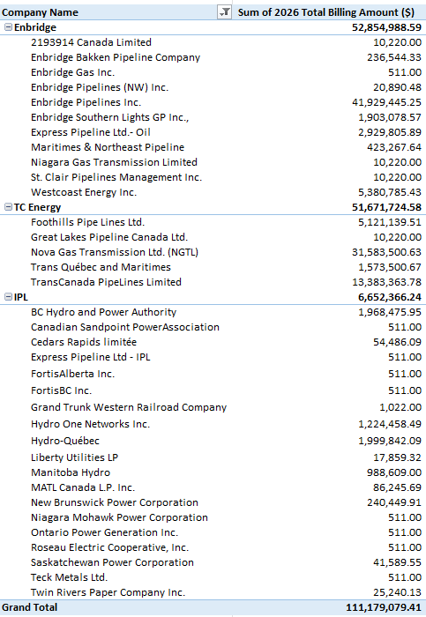
E) CER Allocation and Cost Recovery
Background
The CER is funded through parliamentary appropriations. The Government recovers substantially all of the costs from the regulated industry. The revenues are deposited directly into the Consolidated Revenue Fund. This process is regulated by the National Energy Board Cost Recovery Regulations. The CER’s most recent data indicates the Government of Canada currently recovers approximately 95 percent of parliamentary appropriations (2026)Footnote 4. An estimated 5 percent of costs associated with work in the North are not recovered.
The CER’s Regulatory Framework Plan: 2025-2028 includes a regulatory initiative to update the Regulations to reflect the changes in the regulation-making authority introduced by the CER Act. The CER released a Regulatory Proposal on the cost recovery regulations in November 2021. In fall 2023, an options paper on the methodology for the cost recovery framework was shared with the CRLC PWG with a follow-up workshop to gather additional feedback from the group. The CER is currently exploring broader aspects of cost recovery beyond the recovery mechanism. Once the CER is ready to proceed with external engagement, stakeholders will be provided an opportunity for input.
The CER recovers costs via the National Energy Board Cost Recovery Regulations.
The Office of the Auditor General performs an annual audit of CER cost recovery financial statements.
Key Messages:
- CER cost recovery applies only to CER-regulated companies and facilities.
- Cost recovery is premised on commodity charging. This means that costs are allocated to the principal commodities regulated by the CER (oil, gas, electricity and commodity pipelines) before being allocated to the specific entities in the principal commodities. This is done using time spent on each commodity and activity levels (throughputs and transmission).
- Companies pay their share of recoverable costs in 3 ways:
- Levies under sections 5.2 and 5.3 of the Regulations, are applied to new companies that are not already regulated by the CER (also known as “greenfield” levies)
- Fixed levies (small, intermediate companies and other commodities)
- Proportional levies (large companies)
- The cost recovery framework operates on a three-year billing cycle during which the levies are estimated and subsequently adjusted based on actuals provided by the companies and the CER incurred costs.
- The CER manages a Cost Recovery Liaison Committee (CRLC) that is composed of industry associations and companies to provide a forum to raise issues/concerns relating to cost recovery matters, to discuss accountability reports by the CER; and to discuss upcoming estimates, etc.
- CRLC meetings are typically held twice a year.
- All collections from cost recovery invoices are deposited to the account of the Receiver General for Canada and credited to the Consolidated Revenue Fund.
F) CER Grants and Contributions
The current Grants and Contributions (G&C) Terms and Conditions (T&Cs), modeled on the Impact Assessment Agency’s T&Cs, were approved by TBS in December 2022 and added three new funding streams (Policy Dialogue, Research and Indigenous Capacity Support) to the CER’s previous Participant Funding Program. The T&Cs provide policy coverage for the use of both grants and contributions. For fiscal year 2026-27, including an approved reprofiling of funds from prior years, the CER has 3.73M in Grants and 6.84M in contributions for a total of 10.57M.
Contributions are conditional transfer payments that require recipients to meet specific terms and conditions and are typically subject to reporting and accountability requirements. Recipients must report on how contributions are spent and comply with the terms of the contribution agreement, including eligible costs, activities and performance criteria. A contribution is to be accounted for and is subject to audit.
Examples of where we have used contributions in the last year:
- Taylor to Gordondale (Phase 2 participant funding for s183) All 36 potentially affected Indigenous communities were offered up to 140k to participate and 28 signed contribution agreements.
- CER has multi-year contribution agreements aligned with the term of each Indigenous Advisory Committee (IAC) member. The IAC is an integral part of the CER's governance structure with 8 members from across Canada to integrate Indigenous perspectives and enhance the involvement of Indigenous Peoples in regulation of CER-regulated energy infrastructure.
Grants are unconditional transfer payments which are not subject to accounting by recipients but are subject to pre-established eligibility criteria. The receipt may be required to report on results achieved.
Examples where we have used grants in the last year:
- Taylor to Gordondale 5k Post-GIC decision and 5k incremental Crown consultation grants for Phase 3 participant funding for s. 183 applications
- Indigenous oversight committee (IOF) cowriting committee members – various grants from 2k to 6k aligned with committee activities
- Research grant to St. Mary’s University for Safety Culture Improvement Dialogues enabled 72 industry participants to explore an innovative approach to gathering safety culture insights.
G) Status of Major Applications Before the CER
| Company and Project | Description | Notable facts | Status/Next steps |
|---|---|---|---|
| Electricity-related applications | |||
| Powell River Energy Inc. (PREI) | Application for a permit to export electricity for 30 years under s.356 | On 26 February 2026, the Application was designated for a licensing procedure by Order of the Governor in Council (PC Number 2026-0167). Granted intervenor status:
|
On April 10, 2026, the Commission formally moved PREIs proposed 30-year electricity export from a permit process to a full licensing procedure. The Commission set the scope of issues, granted intervenor status to four parties, and established a detailed procedural timetable that will run through at least fall 2026 before a decision is made. |
| Saskatchewan Power Corporation EHW-001-2025 Southwest Power Pool to SaskPower interconnection 230 kV project |
Application to construct and operate 2 new international power lines. | 2 IPLs: 6.4 km and 6.1 km in southern Sask 3 First Nations and MMF intervening Participant funding offered to Indigenous intervenors No other intervenors |
Commission recently issued potential conditions for comment (27 March 2026). Written argument is set for 10 April – 1 May |
| Pipeline Projects (newest to oldest) | |||
| ATCO Gas
Existing Distribution Pipeline Compliance |
Application under s.214 to apply the CER regulatory framework to 11 existing cross-border gas distribution pipelines in Lloydminster | Small-length facilities, currently being operated under provincial jurisdiction, despite being located within the cross-border city of Lloydminster | Commission is currently assessing the application. |
| Trans Mountain Drag Reducing Agent Application | On 3 February, Trans Mountain applied for the DRA Project - 16 DRA units within the fence lines of 12 existing pump stations along Trans Mountain’s Line 1 and Line 2.
When complete, expected to increase total pipeline throughput by ~10%. |
Three statements of concerns were received on 23 and 24 February 2026.
On 6 March, Commission determined Application sufficiently complete. Category B: - service standard 4 June 2026 - Time limit 2 Oct 2026. 16 March, three additional statements of concern |
On 2 April, 2026, the Commission established additional process to allow interested parties to provide supplemental filings. |
| NGTL Grand Prairie Mainline Loop No. 3 | Colt Section
Located approximately 55 km northwest of Edson, Alberta. Installation of approximately 17.7 km of 48-inch natural gas pipeline - predominately parallels existing ROW |
Includes associated valve sites, an in-line inspection facility at each valve site, and tie-ins to the existing NGTL System. Project will provide additional capacity on the NGTL System’s existing Grande Prairie Mainline pipeline system from the Peace River Area to serve intra-Alberta demand. |
Application filed 12 February 2026; completeness declared on 12 March.
Category C = 300 days legislated time limit |
| NGTL Grand Prairie Mainline Loop No. 3 | Greenview Section
Located near Grande Prairie, Alberta Approx. 15 km of 48-inch natural gas pipeline that predominately parallels existing ROW |
Includes associated valve sites, in-line inspection (ILI) facilities and tie-ins to the existing NGTL System.
Will provide additional capacity on the NGTL System’s existing Grande Prairie Mainline pipeline system from the Peace River Area to serve intra-Alberta demand as well as the East Gate export point. |
Anticipated Application Filing Date: April 2026 |
| NGTL Kainai Interconnect Project | Will consist of installation of a new 1.5-inch hot tap to the existing NGTL Bailey’s Bottom Lateral and approximately 10.5 meters of 1.5-inch pipe to supply gas.
To be located on an existing NGTL GP pipeline ROW |
Pipeline ROW is governed by a registered ROW agreement issued by His Majesty the King in Right of Canada and administered by Indian Oil and Gas Canada
Located on Blood Tribe – Kainai Nation (BT), Reserve (Blood 148) lands located approx. 16 kilometres SW of Lethbridge, Alberta. Participant funding early engagement grant offered |
Application filed 27 January 2026.
Decision or report to be made no later than 450 days after the application is complete. |
| NGTL Yellowhead Mainline Interconnect | Located near Edson, AB and will consist of the installation of 76 m of 30-inch pipeline and new above ground site with various facilities. | The purpose of the Project is to provide a continuous connection between the NGTL System and ATCO ’s proposed Yellowhead Mainline. | Application filed 20 January 2026.
Decision or report to be made no later than 450 days after the application is complete. |
| Niagara Gas Transmission Ltd Rockcliffe Control Station Relocation Project | The Project is proposed to take place in the City of Ottawa mainly on National Capital Commission land.
Existing Rockcliffe Control Station will be removed, while most of the existing outlet pipeline and a small segment of the inlet pipeline downstream of the station inlet valve will be decommissioned. |
A new control station will be constructed approximately 190 m southwest of the old station. | 2 April 2026 Applicant responds to intervenors' requests for information. |
| Westcoast Energy Limited Partnership GH-001-2024 |
Sunrise Expansion Program | Expansion of T-south system 11 gas loops: 139 km total 40 Indigenous intervenors |
Commission report was issued 30 January 2026
Awaiting GIC decision |
| Completed Larger Applications with Commission recommendations & GIC decision | |||
| Pouce Coupé Pipe Line Ltd.
OH-001-2024 |
Taylor to Gordondale Pipeline Project | 89 km oil pipeline 40 conditions 35 Indigenous participants Participant funding offered |
Commission report was issued 7 November 2025
GIC decision was issued 5 February 2026 (P.C. 2026-104 Certificate OC-068 issued on 10 February 2026 |
| NorthRiver Midstream
OH-001-2022 |
NEBC Connector Project | 2 gas lines: 215 km
49 conditions 21 Indigenous participants Participant funding offered |
Certificate issued 28 Dec 2023 |
| NGTL GH-002-2020 |
West Path Delivery 2023 | First certificate application under CER Act 39 km gas pipeline 34 conditions 24 Indigenous participants Participant funding offered |
Certificate issued 1 Dec 2022 |
| NGTL
GH-001-2019 |
Edson Mainline Expansion Project | 85 km gas pipeline 23 conditions 17 Indigenous participants Participant funding offered |
Application under the NEB Act, Report issued by Commission 20 Nov 2020
GIC directed an additional condition Certificate issued 24 June 2021 |
| NGTL (section 183)
GH-002-2019 |
North Corridor Expansion
Application filed with NEB on 4 April 2019; CER issued Commission issued recommendation report 3 Sept 2020; 34 conditions On April 30, 2021, GIC issued Order-in-Council (OIC) No. P. C. 202-1362 directing Commission to issue Certificate |
Completeness determination = 144 days
Hearing phase = 374 days Participant funding offered GIC decision = 239 days (149 days beyond 90 limit) OIC added three conditions and modified four recommended by Commission of the CER One added condition required NGTL to provide funding to Indigenous peoples to support review of NGTL’s condition filings. Other two new conditions and modifications pertained to caribou and habitat management. |
Project went into service in May 2023.
On 3 September, Doig River First Nation filed an application with the Commission to enforce Conditions 36 (Indigenous Working Group for Caribou habitat) and 37 (Caribou Habitat Restoration and Offset Plan). Commission has an open process related to this complaint. |
| Current Toll and Tariff applications | |||
| Trans Mountain RH-002-2023 |
Application under s.230 for tolling on the expanded system | Trans Mountain is continuing to negotiate with Firm Service Shippers and intends to hold an Open Season to evaluate increasing the level of firm contracting on the Trans Mountain Pipeline System. It intends to either file an application with the Commission for approval of a settlement and the Open Season, or a request that the regulatory process for the Application be resumed, by 13 July 2026. | Currently in abeyance. |
| Alta Gas Ltd. | Complaint related to tolls charged by Enbridge Inc. for shortfall payments under the Financial Support Agreement | Commission has heard argument in this matter and is currently deliberating. | |
H) Red Tape Review
In July 2025, the Government of Canada launched an initiative to reduce regulatory red tape, including complicated or outdated processes, unnecessary, duplicative or overly burdensome rules, or inefficient or unpredictable regulatory administration or service delivery. As part of its ongoing mandate, the CER regularly reviews its regulations and related practices to continuously modernize the regulatory system while maintaining safety and the protection of people and the environment.
The CER developed the Red Tape Review Report. This report outlines the recent actions taken and future plans to streamline the CER’s regulatory framework and decision-making processes. The report sets out nine initiatives focused on modernizing regulations, streamlining regulatory processes, and improving information sharing and cooperation, while maintaining strong safety, environmental, and Indigenous rights protections.
The report was published on September 5, 2025, with an updated progress report published on April 13, 2026. In addition to the progress made across all initiatives, three initiatives have now been completed: the Regulatory Pilot Project, the Rapid Review Process, and the Routine Application Decision Timelines Project. The rest are still in progress.
The CER’s Red Tape Review report identified the following initiatives:
Modernizing Regulations and Regulatory Frameworks
- Rules of Practice and Procedure Review
- Export and Import Regulatory Framework Review
- Onshore Pipeline Regulations and Filing Manuals Update
- Regulatory Pilot Project - COMPLETED
Modernizing Regulatory Processes
- CER Portal Project
- Rapid Review Process - COMPLETED
- Routine Application Decision Timelines Project (Section 214) - COMPLETED
- Regulatory Optimization Project
Modernizing Information Sharing and Cooperation
- Regulatory Cooperation
I) Regulatory Optimization and Efficiency Efforts
The CER is committed to regulatory excellence and advancing work focused on improving the efficiency, timeliness, and predictability of the CER’s adjudicative processes.
The CER makes decisions on smaller facilities applications within 10 months and larger facilities in 15 months from when an application is determined to be complete. The CER has been consistently meeting the legislated time limits under the CER Act, but the evolving policy and legislative landscape has underscored the need for the CER to apply an innovative lens to longstanding practices with the goal of strengthening decision-making and enhancing transparency around processes and timelines.
These efforts are aimed at ensuring our processes are focused, effective, and are appropriately responsive to federal government’s policy priorities, while supporting meaningful participation, and reinforcing a resilient regulatory framework. As we advance this work, we remain anchored in our mandate to protect people and the environment and advance meaningful reconciliation.
Key Messages:
- The goal of regulatory efficiency is to enhance safety, compliance, and predictability without compromising standards.
J) Building Canada Act
The CER is working closely with the Impact Assessment Agency of Canada (IAAC) and Major Projects Office (MPO) to support a coordinated approach under the Building Canada Act (BCA).
This approach is guided by the CER’s commitment to Reconciliation, ensuring that processes are efficient, transparent, and grounded in respect for the rights and interests of Indigenous Peoples, while maintaining strong public trust.
The BCA approach is new and evolving and we are working to ensure organizational readiness for future applications. This could include the anticipated submission of a West Coast Oil Pipeline Proposal in June 2026 to the MPO, as contemplated in the Memorandum of Understanding between the Governments of Canada and Alberta.
K) Previous major projects that did not proceed
Project: Enbridge Northern Gateway
Date filed: 27 May 2010
Proponent: Northern Gateway Pipelines Limited Partnership
Commodity: Oil Pipeline
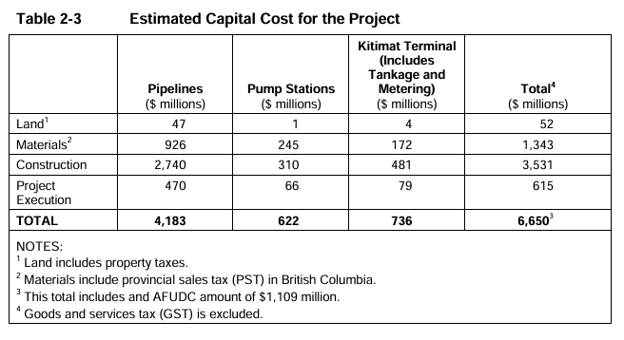
Capital Cost: An estimate of $6.65 billion (Q4, 2009 Canadian dollars) including allowance for funds used during construction (see table 2-3).
Final Status: Cancelled by Federal Government in 2016
Context: On 19 December 2013, the National Energy Board (NEB) issued the Joint Review Panel’s Report recommending to the Governor in Council (GIC) that certificates of public convenience and necessity, incorporating the recommended terms and conditions be issued, for the Enbridge Northern Gateway project. In June 2014, Cabinet approved the project and on 18 June 2014, the NEB issued Certificates OC-060 and OC-061 authorizing its construction and operation.
Litigation started immediately and lasted until 2016. On 23 June 2016, in Gitxaala Nation v. Canada et al., the Federal Court of Appeal quashed the Order in Council and Certificate and remitted the decision to the Governor in Council for redetermination owing to inadequate consultation. In November 2016, Prime Minister Justin Trudeau announced that the federal Cabinet rejected the Northern Gateway Pipeline and would proceed with a permanent crude oil tanker moratorium on British Columbia’s North Coast (later enacted as the Oil Tanker Moratorium Act).
On 6 December 2016, the NEB filed a Project dismissal and rescinding of Certificates OC-060 and OC-061.
Had the project proceeded, the proponent estimated that over a 30-year operating period, Canadian gross domestic product (GDP) would increase by $270 billion. Federal and Provincial governments could collect an additional $81 billion on revenue, and government revenue from pipeline operations would have exceeded $85 million per year. Taxes paid during construction were estimated to exceed $913 million. [Reference: Province of BC IR No.2, PDF page 1 of 41, A2H2F6]
Project: Keystone XL
Date filed: 27 February 2009
Proponent: TransCanada Keystone Pipeline GP Ltd. (Keystone)
Keystone was owned, indirectly, by TransCanada Corporation and ConocoPhillips. Keystone is the general partner acting on behalf of the TransCanada Keystone Pipeline Limited Partnership. This Partnership is also owned by subsidiaries of TransCanada and ConocoPhillips. [Reference: Keystone Application of Keystone XL, section 5.0 Commercial Terms and Tolls, PDF page 1 of 100, A1I0S1] The Project was to be constructed and owned by Keystone and operated by TransCanada PipeLines Limited, who at the time was a wholly owned subsidiary of TransCanada. [Keystone Application of Keystone XL, 2.1 Project Background and Description, PDF page 4 of 14, A1I9R6]
Commodity: Oil
Capital Cost: For the facilities in Canada, an estimated capital cost of $1.7 billion Canadian (2009, Canadian dollars), and the overall total estimated cost of the Keystone XL Pipeline in US $7 billion (2009, Canadian dollars). [Keystone Application of Keystone XL, 2.1 Project Background and Description, PDF page 4 of 14, A1I9R6
Status: TC Energy terminated the Keystone XL pipeline project in 2021 after the required U.S. Presidential Permit was revoked. Although some construction activities had begun on the Canadian side of the border, work was suspended, and ultimately stopped, once the permit was withdrawn.
Context: They Keystone XL pipeline project was formally cancelled by the proponent on 9 June 2021, following the U.S. Biden administration’s revocation of the Presidential Permit on 20 January 2021.
Had the project proceeded, it was expected to contribute approximately $2.4 billion to Canada’s GDP and generate an estimated $30 billion in tax and royalty revenues. [Reference: Pipeline Project – Keystone XL | Alberta.ca]
Project: Energy East
Date filed: 30 October 2014
Proponent: TransCanada PipeLines Limited (TransCanada)
Commodity: Oil
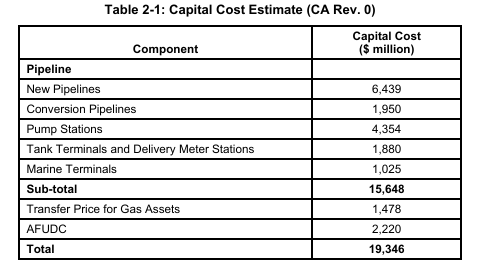
Capital Cost: In the original 2014 application for the Energy East project, the capital cost was approximately $14.4 billion (2014, Canadian dollars). In the revised May 2016 consolidated application, it was estimated to be $19.346 billion (2013, Canadian dollars) (see table 2-1). [Reference: Consolidated Application 2016, PDF page 12 of 60, A76905-4]
Status: TransCanada withdrew its application on 5 October 2017, citing "existing and likely future delays resulting from the regulatory process, the associated cost implications and the increasingly challenging issues and obstacles," facing the project.
Context: The original Energy East pipeline project was filed in October 2014, a substantial amendment was filed by TransCanada in 2015 known as the “Consolidated Application” which included route changes and significant project alterations.
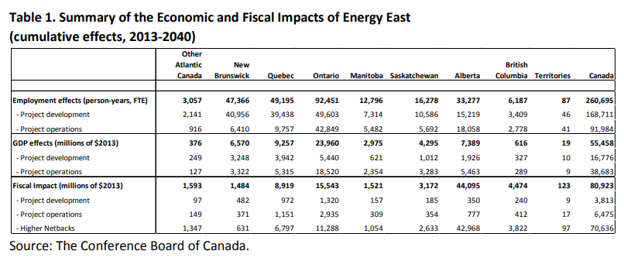
Had the project proceeded, the Project would have produced approximately $80.9 billion (2013, Canadian dollars) worth of fiscal revenues and an estimated $55.458 billion (2013, Canadian dollars) in GDP effects between 2013 and 2040 (see Table 1). [Reference: Energy East, Consolidated Application, Conference Board of Canada Report, PDF page 7 of 64, A76905-8].
L) CER Regulatory Requirements and Timing Statistics
Applications
- From the 2019 fiscal year to the present (March 31, 2026), the CER received and reviewed a total of 5,126 applications which include 1,422 project applications and 3,704 export/import applications.
- There are currently 56 active applications being processed.
- Note: this number refers only the applications the EABU reports on.
- During this period, a total of 5,094 decisions were issued, which include 1,384 project related decisions and 3,710 export/import decisions, with 18 applications being denied.
- Since the 2019 fiscal year, the CER met
- legislative time limits 99.3% of the time and
- service-standards 89.5% of the time for hearings and routine infrastructure applications (Categories A, B, and C), and
- 97.9% of the time for hearings, routine infrastructure, export orders, electricity exports, and COGOA applications.
- CER’s most recent Time Limit and Service Standard Results (2024-25) are available here: CER – Fiscal Year 2024–25 CER Time Limit and Service Standard Results.
CER Adjudicative Timelines
Large Pipeline Project (>40km) Adjudication Timelines since 2019
- Since 2019, the CER has received 6 large pipeline applications, including:
- Edson Main Line Expansion: Completeness determination took 145 days & hearing phase took 451 days (received by the NEB, report issued by the CER).
- North Corridor Expansion: Completeness determination took 144 days & hearing phase took 374 days (received by the NEB, report issued by the CER).
- West Path Delivery 2023: Completeness determination took 154 days & hearing phase took 425 days.
- NEBC Connector: Completeness determination took 286 days & hearing phase took 413 days.
- Taylor to Gordondale Pipeline: Completeness determination took 157 days & hearing phase took 406 days.
- Sunrise Expansion Program: Completeness determination took 173 days & hearing phase took 420 days (report issued Feb. 2, 2026).
ENVIRONMENTAL SCAN
Purpose
The following media summary review has been prepared to support the CER’s parliamentary appearance before the House of Commons Standing Committee on Natural Resources on related to its Main Estimates, 2026-2027. It focuses on mainstream Canadian coverage from April 13–16, 2026, with a focus on energy regulatory policy, Indigenous engagement, and clean energy and resource development. Coverage during this period centres on evolving federal–provincial regulatory roles, critical minerals development, and ongoing debates about the balance between project acceleration, environmental oversight, and Indigenous rights.
Summary
Recent coverage has been both prominent and dynamic, driven by Alberta’s regulatory reforms, federal-provincial tensions, global energy price shocks, and ongoing debates about environmental and Indigenous regulation. The volume of reporting surged in response to Alberta’s introduction of Bill 30, which aims to accelerate approvals for major energy projects, and the federal government’s temporary suspension of fuel taxes amid soaring prices. The tone is mixed: while some outlets highlight opportunities for economic growth and energy export diversification, others raise concerns about environmental oversight, cost recovery, and the implications for Indigenous rights. The direction of reporting is shaped by policy changes, global events (notably the war in Iran), and market volatility, with narratives often reflecting the intersection of economic, environmental, and social priorities.
Strategic Takeaways
- Regulatory Reform Is Shaping the Agenda: Alberta’s Bill 30 and related reforms are driving coverage, with government and industry pushing for expedited approvals to attract investment and double energy production. However, critics warn of risks to environmental and Indigenous oversight, and potential for cost-shifting to taxpayers.
- Cost Recovery and Accountability Debates: The “polluter pays” principle is central, but there is skepticism about whether new strategies will uphold it. Concerns persist about underfunded cleanup funds, orphan wells, and the risk of public liability for environmental remediation.
- Indigenous Rights Are Increasingly Central: Media narratives emphasize that a true energy transition requires Indigenous leadership and governance. Federal and provincial policies are critiqued for insufficient support and capacity-building, with Indigenous-led clean energy projects highlighted as models.
- Global Events Drive Market Volatility and Policy Response: The war in Iran and closure of the Strait of Hormuz have triggered energy price surges, prompting federal tax relief and renewed calls for export diversification. Canadian producers are seen as stable suppliers, but infrastructure bottlenecks and regulatory delays remain obstacles.
- Issues Likely to Surface in Stakeholder Questioning: Expect scrutiny on the effectiveness of regulatory reforms, the integrity of cost recovery mechanisms, the adequacy of Indigenous consultation, and the sector’s ability to respond to global market shifts. Reputational risks may arise from perceived gaps in environmental protection and stakeholder engagement.
- Government: Alberta’s government is highly visible, advocating for regulatory acceleration and economic growth. Federal officials are prominent in discussions of fuel tax relief and clean energy strategy.
- Industry: Energy companies and associations stress the need for competitiveness, highlight increased closure spending, and call for infrastructure expansion. Executives discuss profitability amid price surges but caution against overreliance on war premiums.
- Indigenous Groups: Indigenous leaders and organizations are increasingly featured, emphasizing the necessity of meaningful participation and leadership in energy transition and grid development.
- Environmental & Advocacy Groups: These groups critique regulatory reforms, highlight health and environmental risks, and call for stronger enforcement and investment in clean energy.
- Landowners: Stories of landowners affected by aging wells and environmental impacts are used to illustrate gaps in regulatory protection and enforcement.
Media Coverage by Theme
Regulatory Acceleration & Economic Opportunity
- “Canada’s Natural Gas Output Set for Strong Growth Driven by LNG Exports” (EnergyNow.ca, Apr 16)
- “Alberta eyes accelerated review system for major projects over $250 million” (Yahoo Finance, Apr 14)
- “Alberta Slashes Red Tape with 120-Day Timeline for Major Projects” (The Deep Dive, Apr 14)
- “Alberta Eyes Accelerated Review for Major Projects Over $250M” (The Energy Mix, Apr 16)
- “UCP table legislation for accelerated major projects application review process” (Western Standard, Apr 14)
- “Alberta government introduces 120-day approvals for major energy projects” (CBC, Apr 14)
Cost Recovery & Polluter Pays Principle
- “Aging oil wells on her land are making this Alberta farmer's life miserable. She's not alone” (CBC, Apr 15)
- “Alberta’s cleanup bill and polluter pays principle” (CBK-AM, Apr 15)
- “Cost recovery and mature asset strategy debate” (CBEW-FM, Apr 15)
- “Risks of mature asset strategy and orphan wells” (CBY-AM, Apr 15)
- “Funding gaps in orphan well cleanup” (CBCT-FM, Apr 15)
Indigenous Rights & Energy Transition
- “Pick a path: There is no energy transition without Indigenous nations” (Breach Media, Apr 13)
- “Oil price volatility highlights urgency for federal investment in clean power grid, groups say” (David Suzuki Foundation, Apr 13)
- “Clean energy groups call for East-West grid” (Canadian Reviews, Apr 13)
- “Clean energy groups call for East-West grid connections, investments in renewables” (Vancouver Is Awesome, Apr 13)
Global Events & Market Dynamics
- “In a new CUSMA, should Canada offer the U.S. stronger energy rights?” (Radio-Canada, Apr 13)
- “Energy efficiency and exports, Canada-Africa trade and backbench business on the agenda” (iPolitics.ca, Apr 14)
- “Canada oil and gas profits to surge on Iran war, but firms hold off new investment” (BOE Report, Apr 14)
- “Canadian energy firms to pay debt, shareholders amid price surge” (Financial Post, Apr 15)
- “Energy stocks rally on oil surge with more upside ahead” (Advisor.ca, Apr 13)
- “What a difference a Middle East war makes” (Advisor.ca, Apr 13)
- “Varcoe: LNG top-ranked energy opportunity in Canada, as war sparks global search for more stable supply” Journal, Apr 16)
- “Canada to Temporarily Cut Fuel Taxes Amid Energy-Price Surge” (MarketScreener, Apr 14)
- Date modified: