
Market Snapshot: Canadian electric vehicle sales ride a roller coaster in 2024 and 2025
Connect/Contact Us
Please send comments, questions, or suggestions for Market Snapshot topics to snapshots@cer-rec.gc.ca
Release date: 2026-04-22
For over a decade in Canada, salesFootnote 1 of zero emission vehicles (ZEVs)—battery electric and plug-in hybrid vehicles—had been steadily increasing.Footnote 2 That changed in early 2025 when ZEV sales dropped significantly for the first time since they started to gain popularity in the mid-2010s, taking the rest of the year to recover to early-2024 levels.
Figure 1: Monthly share of ZEVs in new motor vehicle sales compared to annual values since 2021
Source and Text Alternative
Source: Statistics Canada Table 20-10-0085-01 (New motor vehicle sales, monthly), Statistics Canada Table 20-10-0025-01 (New motor vehicle registrations, quarterly)
Text Alternative: This chart shows the share of ZEVs as a portion of new motor vehicle sales in Canada by month in 2024 and 2025. The share rises throughout 2024, then drops significantly in early 2025, after which it gradually recovers to early-2024 levels. The monthly ZEV share of new vehicle sales is contrasted with straight lines showing the annual ZEV shares of new motor vehicle sales for each of 2021, 2022, 2023 and 2024. This provides context for the monthly values in 2024, which climb above the 2024 annual value, then drop to below the 2022 level, and recover to between 2023 and 2024 levels by December 2025. New motor vehicle sales data for ZEVs is only available for 2024 and 2025. Prior to 2024 we use new vehicle registrations as a proxy for sales for previous years.
Figure 1 shows the monthly ZEV share of Canadian new motor vehicle sales in 2024 and 2025 along with annual ZEV sales shares from 2021 to 2024 to provide historical comparative context. In 2024, ZEV shares reached new heights, making up 14% of new annual sales—even reaching nearly 20%, or 1 in 5 vehicles sold, in some months. Then in early 2025, ZEV shares dropped down to 2022 levels for much of the year (around 7-8%). Reasons for this decline are covered in a previous Market Snapshot, and include eliminations and/or reductions of various federal and provincial EV incentive programs, economic uncertainty, and consumer backlash against Tesla, the best-selling EV brand in Canada. In the latter months of 2025, ZEV shares recovered, ending the year at 12.5% in December, which is above the 2023 annual share, and about where it was in the early months of 2024. Annually in 2025, the ZEV sales share was 8.7%, which falls between the 2022 and 2023 annual values.
While ZEV sales fell non-plug-in gasoline hybrid electric vehicles showed a notable increaseFootnote 3. Non-plug-in hybrids are not ZEVs, they are internal combustion engine vehicles with a rechargeable battery pack to provide extra power. Non-plug-in hybrids have improved fuel efficiency, but they do not operate for significant lengths of times in only electric mode like plug-in hybrid vehicles do, and are not considered zero emissions.Footnote 4 Non-plug-in hybrid vehicle sales grew by 61,000 from 2024 to 2025, compared to growth of 33,000 from 2023 to 2024. Sales of conventional gasoline and diesel vehicles grew by over 40,000 from 2024 to 2025. While new vehicle sales are still dominated by gasoline and diesel vehicles (~75-80% of the total), the rise of ZEVs and non-plug-in hybrid vehicles have diversified the vehicle mix. New registrations for conventional vehicles, as well as total vehicle sales, remain below pre-pandemic levels (Figure 2).
Figure 2: Total new vehicle registrations by fuel type, 2017 to 2025
Source and Text Alternative
Source: Statistics Canada Table 20-10-0025-01 (New motor vehicle registrations, quarterly)
Text Alternative: This area chart shows total new vehicle registrations, by fuel type, from 2017 to 2025 on a quarterly basis. In early years within this range, gasoline vehicles made up the vast majority of new vehicle registrations, which is a proxy for new vehicle sales. However, in the first half of the 2020s, battery electric vehicles, hybrid electric vehicles, and plug-in hybrid electric vehicles grow as part of the mix.
In early February 2026, the Federal government announced several key policy changes that could shape the future of ZEV adoption in Canada. Near-term ZEV sales could be boosted by the launch of the five-year Electric Vehicle Affordability Program (EVAP) which started in February 2026 at $5,000 for battery electric and fuel-cell electric vehicles, and $2,500 for plug-in hybrid vehicles—the same amounts as in the previous Government of Canada iZEV incentive program. These incentives will be gradually phased down to $2,000 and $1,000, respectively, in 2030. Longer term, the government announced that it would repeal the Electric Vehicle Availability Standard, which required ZEV sales reach 60% of new vehicle sales by 2030 and 100% by 2035. In its place, the government announced new plans—including strengthened vehicle emission standards and investments in charging infrastructure—which the Government of Canada expects to reach a 75% EV adoption rate by 2035, with an aspirational goal of 90% by 2040.
The Canada Energy Regulator (CER)’s latest energy outlook, Canada’s Energy Future 2026, shows how rising electricity demand in the transportation sector could be an important part of overall electricity demand growth. All four scenarios in the outlook include significant growth in Canadian electricity demand between now and 2050. The transportation sector accounts for 17 to 42% of end-use electricity demand growth, depending on the scenario, alongside other key drivers such as data centre loads and electrification of buildings and industry. This demand growth is based on ZEV policies as they were before the changes announced in early February 2026.
10 years of EV Market Snapshots
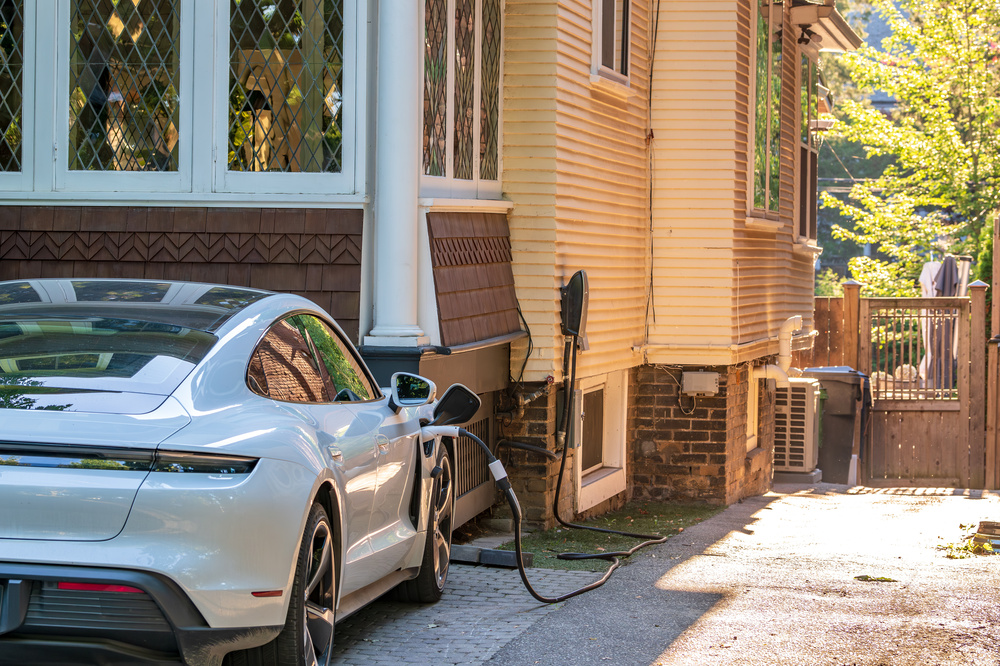
The CER first covered the early rise of ZEVs 10 years ago in 2016: Market Snapshot: Lower costs, better technology, and provincial policies are helping grow Canada’s small fleet of electric vehicles. At that time, ZEV sales data—which had to be merged from various sources as Statistics Canada would not begin publishing comprehensive data on these emerging technologies until 2017—showed an emerging technology gaining a foothold. The 2016 snapshot charts the rise of ZEVs sales from essentially zero in 2010, to 0.37% of sales in 2015. The 2015 value, representing 6,930 vehicles sold, was less than 5% of the over 170,000 ZEVs sold in 2025. Since then the CER has published several Market Snapshots about ZEVs, covering various aspects such as range, emission intensity, cost of ownership, and energy efficiency.
- Date modified: